Fahrenheit 451, Ray Bradbury
Del Rey (Ballantine), 1953, 179 pages
I read this when I was in the 10th grade, and revisiting it was kind of a bummer, because it just wasn't that good. (Well, it did win the National Book Award.) I've always remembered it as one of the best books I was required to read in high school. I can see exactly why it appealed to my 15-year-old self--ornate, overblown language that I considered literary and a clear message that was delivered largely in impassioned speeches by various characters--and those are exactly the reasons I dislike it now. The plot is flimsy, the characters one-dimensional, and the author clearly has an axe to grind. Bradbury also rants (in the book itself and in his various afterwords) about the tyranny of minorities and how objections to works of literature on the grounds of racial/gender/religious sensitivity will be the downfall of aesthetics and society. Which is, you know, real cute, but off-putting. He refers to "women's libbers" in a supplementary interview (also included in the book) that was conducted in 2003, which is just plain embarrassing. The "women's libbers" have a point: the only roles women play in this book are brainwashed wife (Mildred) or non-threatening catalyst (sort of a muse) for the male character's important revelations (Clarisse). I found it especially striking that the nomads at the end of the book, the ones who have memorized various works of literature and now represent the repository of human knowledge in the book-burning era, are all specifically referred to as men. Perhaps Bradbury thought that a mixed-gender nomad camp would provide too many distractions.
A funny side note: For quite a while, in my support for ebooks as a medium, I had in the back of my mind a moment in Fahrenheit 451 where Faber tells Montag that it's the message that matters, not the medium, and that in fact even the TV parlors could serve the same purpose as literature if they would project "the same infinite detail and awareness." Turns out that Bradbury has refused to allow ebook versions of his books for years, and has only in the past year or so been forced into accepting an ebook deal with the realization that no publisher would renew his print contract without an ebook component. I have as much fondness for the physical components of a book as anyone, and I do think there's a debate to be had about what modern technology has done to our attention spans, but I find most arguments against ebooks to be hopelessly sentimental. A book is so much more than just paper and ink and glue.
Showing posts with label literary fiction. Show all posts
1.06.2012
48. Things Fall Apart
Things Fall Apart, Chinua Achebe
Anchor Books, 209 pages, 1959
One funny consequence of my awful procrastination on the 50-book challenge is that to clean up, I ended up reading lots of short but wonderful books that I would never have otherwise gotten around to. Somewhere I had gotten the idea that this book was highbrow, difficult, and maybe a little male-focused (which I tend to find tedious), but it was just the opposite.
Things Fall Apart is a portrait of Ibo tribal life at the end of the 19th century, and Achebe's plain, rhythmic writing style gives it the power of myth. Although parts of the culture portrayed in the book (such as the custom of leaving twins to die in the forest, or the murder of Okonkwo's adopted son, Ikemefuna, on the order of the village oracle) will seem brutal to modern readers no matter what, it's a far cry from Heart of Darkness*, which Achebe was in part responding to and refuting when he wrote his novel. The top review on Amazon says that Achebe gives the wild, "savage" drumbeats in Heart of Darkness a story and a context, which I think is the main function of the novel--the average American has a backwards view of Africa and its people, but Achebe gives us an intimate look at the customs, traditions, personalities, and daily life in one Ibo village. It's also an interesting look at power and how it affects social change--Okonkwo, the village strong man, upholds customs he finds repellent because he is afraid of appearing weak, while those at the bottom of the social food chain who have nothing to lose are the ones who most readily join the Christian missionaries when they come and eventually upset the balance of tribal life.
*Heart of Darkness was saved from earning the title of worst book I was required to read in high school only due to the presence of Lord of the Flies. Dear Folsom Cordova Unified School District, get with the fucking program. Throwing in The Joy Luck Club and calling it a day does not a female minority perspective make.
Anchor Books, 209 pages, 1959
One funny consequence of my awful procrastination on the 50-book challenge is that to clean up, I ended up reading lots of short but wonderful books that I would never have otherwise gotten around to. Somewhere I had gotten the idea that this book was highbrow, difficult, and maybe a little male-focused (which I tend to find tedious), but it was just the opposite.
Things Fall Apart is a portrait of Ibo tribal life at the end of the 19th century, and Achebe's plain, rhythmic writing style gives it the power of myth. Although parts of the culture portrayed in the book (such as the custom of leaving twins to die in the forest, or the murder of Okonkwo's adopted son, Ikemefuna, on the order of the village oracle) will seem brutal to modern readers no matter what, it's a far cry from Heart of Darkness*, which Achebe was in part responding to and refuting when he wrote his novel. The top review on Amazon says that Achebe gives the wild, "savage" drumbeats in Heart of Darkness a story and a context, which I think is the main function of the novel--the average American has a backwards view of Africa and its people, but Achebe gives us an intimate look at the customs, traditions, personalities, and daily life in one Ibo village. It's also an interesting look at power and how it affects social change--Okonkwo, the village strong man, upholds customs he finds repellent because he is afraid of appearing weak, while those at the bottom of the social food chain who have nothing to lose are the ones who most readily join the Christian missionaries when they come and eventually upset the balance of tribal life.
*Heart of Darkness was saved from earning the title of worst book I was required to read in high school only due to the presence of Lord of the Flies. Dear Folsom Cordova Unified School District, get with the fucking program. Throwing in The Joy Luck Club and calling it a day does not a female minority perspective make.
Labels:
1950s,
50-book challenge,
books,
literary fiction,
modern classics
12.28.2011
46. Notes from Underground
Notes from Underground, Fyodor Dostoevsky
Bantam Books, 153 pages, 1864, translated by Mirra Ginsburg in 1974
I put off reading this forever and ever and ever because of Dostoevsky's reputation as a dense, difficult, cerebral novelist, but finally the book challenge forced me to give in because it was one of the few short books I had left to read and now I wonder what took me so long.
I swear to God I read somewhere that the Beat Generation was heavily influenced by Notes from Underground, and now I can't find any reference to it, which is too bad because reading it gave me a new way of approaching the main question I had about On the Road: if Jack Kerouac honestly believes in the Beat way of life (as he seems to), why does it come across as so repugnant? (Or, since he's apparently self-aware enough to realize how destructive it is, why does he believe so fervently in it?) At the time I read it I came to the conclusion that he was just painting a picture of the Beat Generation in the entirety of its glory and despair. In Notes from Underground, though, the underground man prioritizes freedom and self-expression over happiness and well-being, saying that "man, whoever he might be, has always and everywhere preferred to act according to his own wishes rather than according to the dictates of reason and advantage." He goes on to portray base, random, irrational acts as a sort of rebellion against 18th-century ideas of human nature as essentially good and rational, saying that "though [human nature] may be wrong, it's nevertheless alive." I think this is what On the Road is getting at--freedom at any cost; putting authenticity and ecstasy and experience above stability and order and well-being.
(This is not all I got out of Notes from Underground, by the way--it's just the only thing I can say that somebody else hasn't already said better.)
Bantam Books, 153 pages, 1864, translated by Mirra Ginsburg in 1974
I put off reading this forever and ever and ever because of Dostoevsky's reputation as a dense, difficult, cerebral novelist, but finally the book challenge forced me to give in because it was one of the few short books I had left to read and now I wonder what took me so long.
I swear to God I read somewhere that the Beat Generation was heavily influenced by Notes from Underground, and now I can't find any reference to it, which is too bad because reading it gave me a new way of approaching the main question I had about On the Road: if Jack Kerouac honestly believes in the Beat way of life (as he seems to), why does it come across as so repugnant? (Or, since he's apparently self-aware enough to realize how destructive it is, why does he believe so fervently in it?) At the time I read it I came to the conclusion that he was just painting a picture of the Beat Generation in the entirety of its glory and despair. In Notes from Underground, though, the underground man prioritizes freedom and self-expression over happiness and well-being, saying that "man, whoever he might be, has always and everywhere preferred to act according to his own wishes rather than according to the dictates of reason and advantage." He goes on to portray base, random, irrational acts as a sort of rebellion against 18th-century ideas of human nature as essentially good and rational, saying that "though [human nature] may be wrong, it's nevertheless alive." I think this is what On the Road is getting at--freedom at any cost; putting authenticity and ecstasy and experience above stability and order and well-being.
(This is not all I got out of Notes from Underground, by the way--it's just the only thing I can say that somebody else hasn't already said better.)
12.27.2011
42. The Lake
The Lake, Banana Yoshimoto
Melville House, 188 pages, 2005, translated by Michael Emmerich in 2011
It's probably a function of language or translation or some combination of the two, but all the modern Japanese authors I've read--Haruki Murakami, Yoko Ogawa, Banana Yoshimoto, to some extent even Mishima--share certain qualities of style: extreme care and attention in describing discrete physical objects (a carton of milk in Murakami's Kafka on the Shore, grapefruit jelly in Ogawa's Pregnancy Diary, a wire grilling rack in The Lake), combined with a certain vagueness of feeling, told in a voice characterized by colloquialism and familiarity and a very Japanese measure of ambivalence (lots of "you know" and "well, I" and "that's just the way I feel"). I really love this style and it's probably part of why I can read any of the above authors writing about any damn old thing.
The Lake centers around the relationship between optimistic artist Chihiro and oddball grad student Nakajima. Chihiro is strong and independent, but in facing her mother's death comes to realize that she is still in a way trying to escape the small town she grew up in; she enters a tentative relationship with Nakajima, supporting him through his attempt to overcome childhood trauma. I wouldn't call it a brilliant plot--although Nakajima constantly alludes to a terrible secret that is revealed near the end of the book, nothing ever really happens--but Chihiro's inner world is so rich and detailed that there's always something to come back to, something more to explore and ponder. After this book I'm looking forward to reading more Banana Yoshimoto!
Melville House, 188 pages, 2005, translated by Michael Emmerich in 2011
It's probably a function of language or translation or some combination of the two, but all the modern Japanese authors I've read--Haruki Murakami, Yoko Ogawa, Banana Yoshimoto, to some extent even Mishima--share certain qualities of style: extreme care and attention in describing discrete physical objects (a carton of milk in Murakami's Kafka on the Shore, grapefruit jelly in Ogawa's Pregnancy Diary, a wire grilling rack in The Lake), combined with a certain vagueness of feeling, told in a voice characterized by colloquialism and familiarity and a very Japanese measure of ambivalence (lots of "you know" and "well, I" and "that's just the way I feel"). I really love this style and it's probably part of why I can read any of the above authors writing about any damn old thing.
The Lake centers around the relationship between optimistic artist Chihiro and oddball grad student Nakajima. Chihiro is strong and independent, but in facing her mother's death comes to realize that she is still in a way trying to escape the small town she grew up in; she enters a tentative relationship with Nakajima, supporting him through his attempt to overcome childhood trauma. I wouldn't call it a brilliant plot--although Nakajima constantly alludes to a terrible secret that is revealed near the end of the book, nothing ever really happens--but Chihiro's inner world is so rich and detailed that there's always something to come back to, something more to explore and ponder. After this book I'm looking forward to reading more Banana Yoshimoto!
12.12.2011
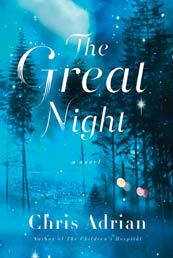
34. The Great Night
The Great Night, Chris Adrian
Farrar, Straus and Giroux ebook, 310 pages, 2011
Holy Shakespeare I am behind on book posts. It's actually been more than a month since I read this now. The Great Night is Adrian's retelling (more of an homage, really) of A Midsummer Night's Dream, set in Buena Vista Park in modern-day San Francisco. Oberon and Titania are recast as supernatural parents who have recently lost their young son to leukemia; the acting troupe becomes a group of homeless people determined to speak out via musical theater about (what they believe is) the mayor's plan to turn the city's homeless into food, and the original play's four lovers are now three heartbroken San Franciscans who become lost in the park on their way to a party. It reminded me a lot of early Francesca Lia Block, after Weetzie Bat but before all the dark confessional stuff, seamlessly and whimsically weaving faeries and magical creatures into a modern-day urban scene--not literary, necessarily, but entertaining and bawdy and a whole lot of fun. On the other hand, my opinion of the book is mixed--I agree with one review (which I can't find now) that said the portrayal of Titania and Oberon as godlike creatures who ultimately cannot prevent or deal with their son's death was by far the best-written and most moving part of the book. The stories of the three human lovers never quite reach a satisfying conclusion, only a threesome.
Farrar, Straus and Giroux ebook, 310 pages, 2011
Holy Shakespeare I am behind on book posts. It's actually been more than a month since I read this now. The Great Night is Adrian's retelling (more of an homage, really) of A Midsummer Night's Dream, set in Buena Vista Park in modern-day San Francisco. Oberon and Titania are recast as supernatural parents who have recently lost their young son to leukemia; the acting troupe becomes a group of homeless people determined to speak out via musical theater about (what they believe is) the mayor's plan to turn the city's homeless into food, and the original play's four lovers are now three heartbroken San Franciscans who become lost in the park on their way to a party. It reminded me a lot of early Francesca Lia Block, after Weetzie Bat but before all the dark confessional stuff, seamlessly and whimsically weaving faeries and magical creatures into a modern-day urban scene--not literary, necessarily, but entertaining and bawdy and a whole lot of fun. On the other hand, my opinion of the book is mixed--I agree with one review (which I can't find now) that said the portrayal of Titania and Oberon as godlike creatures who ultimately cannot prevent or deal with their son's death was by far the best-written and most moving part of the book. The stories of the three human lovers never quite reach a satisfying conclusion, only a threesome.
7.01.2011
18. F. Scott Fitzgerald: This Side of Paradise and 19. Yukio Mishima: The Sound of Waves
Vintage (Random House), 264 pages, 1920
I read this as a pretentious 15-year-old and fully expected it to have failed the test of time eight years later. The only reason I wanted to read it again was because I was reading a biography of legendary Scribner editor Max Perkins before coming to Japan (which I never finished--might try to bring it back with me when I go on my trip home), and this was the novel that launched Perkins's (and Fitzgerald's) career. While rereading it I remembered how much it once meant to me, and discovered that even after college, the coming-of-age story of a self-absorbed, lazy, self-styled intellectual at Princeton wasn't half bad. I think I considered myself a female version of protagonist Amory Blaine when I first read it, and I want to be able to look back and say "Oh God, I was so full of it," but I kind of can't help but admire my teenage self for managing to be so damn earnest about this whole literature thing back when intellect was not considered a desirable trait by my peer group and Thursday Night Market was the closest thing to culture there was in town.
The Sound of Waves, Yukio Mishima
Vintage International (Random House), 183 pages, 1954, translated by Meredith Weatherby in 1956
After The Sailor Who Fell from Grace with the Sea, reading a Mishima novel where both the hero and heroine are good, simple people and virtue triumphs over evil in the end was... strange, to say the least. I really enjoyed it, though! The writing is beautiful and it's full of all the now-familiar little details about Japanese village life (visiting the local shrine, meeting neighbors at the public bath, junior high school kids going on the yearly trip to Kyoto).
Next up: East of Eden by John Steinbeck
6.13.2011
15. Larry Watson: Montana 1948
Montana 1948, Larry Watson
Washington Square Press, 175 pages, 1993
Damn, I'm behind on book posts. I'm on book number 18 now, so I'll try to get through these quickly and get caught up. Anyway, I picked this up at random at the midyear seminar book sale, having never heard of the book or its author before, and was quite pleasantly surprised. The obvious comparison is to To Kill a Mockingbird: small American town, racial injustice, a father taking a difficult stand for what's right, told through a child's eyes. I haven't read To Kill a Mockingbird in about a million years (okay, I can tell you exactly how many years: eight. Oh God.), so I can't really compare the two in any significant way, but I did enjoy Montana 1948. Watson has that kind of writing style that doesn't call attention to itself; it's so easy and transparent that you almost don't notice how well-crafted it is. It's a short read, and suspenseful, but also a good and important one.
Next up: The Left Hand of Darkness by Ursula K. Le Guin
Damn, I'm behind on book posts. I'm on book number 18 now, so I'll try to get through these quickly and get caught up. Anyway, I picked this up at random at the midyear seminar book sale, having never heard of the book or its author before, and was quite pleasantly surprised. The obvious comparison is to To Kill a Mockingbird: small American town, racial injustice, a father taking a difficult stand for what's right, told through a child's eyes. I haven't read To Kill a Mockingbird in about a million years (okay, I can tell you exactly how many years: eight. Oh God.), so I can't really compare the two in any significant way, but I did enjoy Montana 1948. Watson has that kind of writing style that doesn't call attention to itself; it's so easy and transparent that you almost don't notice how well-crafted it is. It's a short read, and suspenseful, but also a good and important one.
Next up: The Left Hand of Darkness by Ursula K. Le Guin
6.08.2011
14. John Updike: Rabbit, Run
Rabbit, Run, John Updike
Fawcett Books (Random House/Ballantine), 264 pages, 1960
When I was about 16 and trying desperately to seem intellectual, I pulled this off the shelf at the Folsom Library, read the summary on the back, and put it back because I thought it was about basketball. I'm kind of glad I did because I don't think I was ready to read it then. It took me a while to get into it this time, despite the beautiful prose. What finally gave me an "in" was reading on Wikipedia that Updike wrote it as a response to Kerouac's On the Road (which was the first and only book read by the ill-fated Joetsu book club last year). I have no idea whether that's true, but having spent so much time dissecting On the Road, thinking about the two books together helped me realize what exactly the story was that Updike was trying to tell.
The stories are actually very similar--dumb, misogynist everyman decides that the tedium of American family life is beneath him and that he's meant for something greater, takes off on road trip, eventually is smacked in the face by divine retribution (Dean Moriarty goes crazy; Rabbit's wife accidentally drowns their daughter). But the writers take completely different approaches. Kerouac really believes in the lifestyle he sets forth in his books, and describes it with breathless joy; Updike is more cautious, and makes it clear that what he's describing is an attempt to escape from something that has no escape. There are so many late '50s/early '60s American novels on this theme--if you were a thinking person in America at that time, it seems, you were looking for a way out.
There is one more novel I've read recently that fits this formula: Revolutionary Road by Richard Yates. I read Rabbit, Run the way you take medicine (it's good for you), and On the Road was like a trainwreck (can't look away), but I genuinely enjoyed Revolutionary Road, and I finished it in about 3 days. The difference, I think, is that it tells the story of a married couple instead of a single male protagonist, and so includes a female perspective. In fact, the wife, April Wheeler, is the one pushing for the family's escape to Europe--she's the smart one, the one who acts, causing her husband to react. Rabbit Angstrom and Dean Moriarty can go to hell, but I actually felt for the Wheelers as I watched their lives get torn apart.
Next up: Montana 1948 by Larry Watson
Fawcett Books (Random House/Ballantine), 264 pages, 1960
When I was about 16 and trying desperately to seem intellectual, I pulled this off the shelf at the Folsom Library, read the summary on the back, and put it back because I thought it was about basketball. I'm kind of glad I did because I don't think I was ready to read it then. It took me a while to get into it this time, despite the beautiful prose. What finally gave me an "in" was reading on Wikipedia that Updike wrote it as a response to Kerouac's On the Road (which was the first and only book read by the ill-fated Joetsu book club last year). I have no idea whether that's true, but having spent so much time dissecting On the Road, thinking about the two books together helped me realize what exactly the story was that Updike was trying to tell.
The stories are actually very similar--dumb, misogynist everyman decides that the tedium of American family life is beneath him and that he's meant for something greater, takes off on road trip, eventually is smacked in the face by divine retribution (Dean Moriarty goes crazy; Rabbit's wife accidentally drowns their daughter). But the writers take completely different approaches. Kerouac really believes in the lifestyle he sets forth in his books, and describes it with breathless joy; Updike is more cautious, and makes it clear that what he's describing is an attempt to escape from something that has no escape. There are so many late '50s/early '60s American novels on this theme--if you were a thinking person in America at that time, it seems, you were looking for a way out.
There is one more novel I've read recently that fits this formula: Revolutionary Road by Richard Yates. I read Rabbit, Run the way you take medicine (it's good for you), and On the Road was like a trainwreck (can't look away), but I genuinely enjoyed Revolutionary Road, and I finished it in about 3 days. The difference, I think, is that it tells the story of a married couple instead of a single male protagonist, and so includes a female perspective. In fact, the wife, April Wheeler, is the one pushing for the family's escape to Europe--she's the smart one, the one who acts, causing her husband to react. Rabbit Angstrom and Dean Moriarty can go to hell, but I actually felt for the Wheelers as I watched their lives get torn apart.
Next up: Montana 1948 by Larry Watson
Labels:
1950s,
50-book challenge,
Kerouac,
literary fiction,
modern classics,
Plath,
Updike
2.07.2011
3. Yasunari Kawabata: Snow Country
Snow Country, Yasunari Kawabata
Vintage International, 192 pgs., 1947, translated by Edward G. Seidensticker in 1957You want to hear about snow country? Let me tell you about snow country. You know, in case you were wondering whether I was qualified to review a book about wasted effort and lots and lots of snow:
(all taken from the front of my house)
Now that that's out of the way, Snow Country. I'll be honest; I didn't like it. This was the book club book for January, and I also know a few other people around here who have read it in English, and all of us have the same opinion: something was definitely lost in translation. It's about the relationship between a geisha and a visiting Tokyo urbanite in Niigata Prefecture in the 1930s, and it was one of three novels for which Kawabata won the Nobel Prize, which I think is the reason none of us have just dismissed it outright. Not only is it critically acclaimed, it's also about the little corner of the world that we've chosen to call home. We want so badly to be proud of it, like we are of our sake and our rice and our Kenshin, but I just couldn't make myself like it. There are some beautiful images contained within it, but the story left me cold.
(See what I did there?)
In his Nobel Prize acceptance speech, Kawabata says this:
Yet in the sad, austere, autumnal qualities so valued by the tea ceremony, itself summarized in the expression "gently respectful, cleanly quiet", there lies concealed a great richness of spirit; and the tea room, so rigidly confined and simple, contains boundless space and unlimited elegance.Kawabata's writing was heavily influenced by haiku poetry, which I think also shares the qualities which he here associates with tea ceremony--wabi-sabi, mono no aware, all those Japanese cultural ideals that have to do with transience and imperfection. I haven't spent much time reading or learning about haiku, but when I have read them (and other forms of Japanese poetry like the waka of the Kokinshu--all in translation, of course), I've generally found them to be pretty accessible, and I'm totally down with the idea of wabi-sabi.
Yet I still couldn't get into this. I think when it comes down to it, I just didn't find the characters compelling enough to invest the time and energy into exploring the book's relationship to haiku, which seems to be its main redeeming factor. The chronology of events was difficult to follow. I don't know a whole lot about geisha culture, which I'm sure impeded my understanding of the book. It was originally published in serial form, and parts of it were written much later than others, which gave it a choppy, non-continuous feel.
I have a hard time accepting cultural relativism in literature. A lot of people who read Snow Country in English seem to explain its impermeability by saying that it's just "too Japanese" to be accessible to the Western reader, but I hate that, and not just because it reeks of orientalism--I want to believe that if it's art, that it will resonate with the human experience no matter who you are or what time and place you come from. Maybe that's silly--I haven't read a whole lot outside of the Western tradition, and I don't have the energy or the desire to really spend a lot of time trying to find redeeming qualities in books that don't speak to me when there is so much else out there to read, so I may never find out whether it's a cultural divide or my own laziness that's the cause. I can say that I found The Sailor Who Fell from Grace with the Sea much more compelling, even though I didn't like its characters, either; the writing was much more consistent and I found the story absorbing in spite of myself.
Anyway, womp womp, can't like them all. I finished this quite some time ago and I've actually finished two other books since then, so those entries are coming up, I promise!
Next up: Guns, Germs, and Steel by Jared Diamond
1.05.2011
1. Yukio Mishima: The Sailor Who Fell from Grace with the Sea
The Sailor Who Fell from Grace with the Sea, Yukio Mishima
Tuttle, 181 pgs., 1963, translated by John Nathan in 1965
Before I start here I feel compelled to mention (because SOMEONE will throw a fit if I don't) that although I started reading this book in 2010, I didn't pick it up the whole week I was in Tokyo. By the time the trip was over I had lost the thread of the story (not to mention any hope of understanding anything deeper), so I began again from the first page yesterday and finished it the same day. I officially read the whole book in 2011, so I don't want to hear any more whining that I'm cheating. Better step up your game, bitches.
That said, my goal this year is to not only read a lot, but also to retain what I've read. There are so many great books that have passed through me like sand simply because I read them and then put them back on the shelf without a second thought. For me it takes thinking, rereading, supplementary materials, writing, and discussion to fully digest a book, so I'm hoping to blog all the books I read this year to get used to thinking about literature. I'm rusty--I've been out of school for a year, and I haven't taken a good literature class since I was 18. But I'm hoping that this will force me to have something smart to say about each book I read this year, and that, like a muscle, the ability will grow with repeated use.
If we're going to extend the metaphor, though, picking The Sailor Who Fell from Grace with the Sea for my first book of 2011 is like running a marathon without training. It's not Finnegan's Wake, but I found it pretty damn inaccessible in parts. The back cover text alludes to Mishima's belief that Japan "will only become truly great once more when she forcibly purges herself of all Western influence." Without reading that, I could have taken the book as an isolated tale of disillusionment and insanity, but that blurb taunted me into trying to discover an allegory in the characters' lives (which is an interesting comment on how the cover material influences how we experience a book). Part of the problem is that I can't find any information on Mishima's nationalist views. According to his Wikipedia entry, he was strongly influenced by Western literature--so did he only resent Western military influence as opposed to cultural influence, or was he just a contradictory figure?
The book centers around the relationship between Noboru, a 13-year-old boy; his mother, Fusako; and Ryuji, Fusako's lover and the titular sailor. Fusako clearly stands for Western influence--she runs an upscale import clothing shop, and has Ryuji wear expensive Western suits and take English conversation lessons so that he can take over the business. And the sailor Ryuji would be Japan, caught between his seafaring life and vague notions of future "glory" on one side, and a domesticated life on shore with Fusako on the other. It's with Noboru that the allegory idea begins to break down for me--as the character who takes it upon himself to restore Ryuji to his former heroism, he would be the character most strongly identified with Mishima's own views, but he and his gang are deliberately presented as childish, and the gang's chief in particular is both completely insane and strangely helpless, his insanity the obvious result of his parents' neglect. All of the characters, in fact, come off as pathetic, which is why I want to read it as a tale of social decay and not an expression of Mishima's political views.
The prose is beautiful, and the book is quite short, though it's too disturbing to be described as an easy read. I bought another Mishima book, The Sound of Waves, when I was in Tokyo--it sounds quite different from this one, and I'm excited to read it.
Next up: Room by Emma Donoghue
Tuttle, 181 pgs., 1963, translated by John Nathan in 1965
Before I start here I feel compelled to mention (because SOMEONE will throw a fit if I don't) that although I started reading this book in 2010, I didn't pick it up the whole week I was in Tokyo. By the time the trip was over I had lost the thread of the story (not to mention any hope of understanding anything deeper), so I began again from the first page yesterday and finished it the same day. I officially read the whole book in 2011, so I don't want to hear any more whining that I'm cheating. Better step up your game, bitches.
That said, my goal this year is to not only read a lot, but also to retain what I've read. There are so many great books that have passed through me like sand simply because I read them and then put them back on the shelf without a second thought. For me it takes thinking, rereading, supplementary materials, writing, and discussion to fully digest a book, so I'm hoping to blog all the books I read this year to get used to thinking about literature. I'm rusty--I've been out of school for a year, and I haven't taken a good literature class since I was 18. But I'm hoping that this will force me to have something smart to say about each book I read this year, and that, like a muscle, the ability will grow with repeated use.
If we're going to extend the metaphor, though, picking The Sailor Who Fell from Grace with the Sea for my first book of 2011 is like running a marathon without training. It's not Finnegan's Wake, but I found it pretty damn inaccessible in parts. The back cover text alludes to Mishima's belief that Japan "will only become truly great once more when she forcibly purges herself of all Western influence." Without reading that, I could have taken the book as an isolated tale of disillusionment and insanity, but that blurb taunted me into trying to discover an allegory in the characters' lives (which is an interesting comment on how the cover material influences how we experience a book). Part of the problem is that I can't find any information on Mishima's nationalist views. According to his Wikipedia entry, he was strongly influenced by Western literature--so did he only resent Western military influence as opposed to cultural influence, or was he just a contradictory figure?
The book centers around the relationship between Noboru, a 13-year-old boy; his mother, Fusako; and Ryuji, Fusako's lover and the titular sailor. Fusako clearly stands for Western influence--she runs an upscale import clothing shop, and has Ryuji wear expensive Western suits and take English conversation lessons so that he can take over the business. And the sailor Ryuji would be Japan, caught between his seafaring life and vague notions of future "glory" on one side, and a domesticated life on shore with Fusako on the other. It's with Noboru that the allegory idea begins to break down for me--as the character who takes it upon himself to restore Ryuji to his former heroism, he would be the character most strongly identified with Mishima's own views, but he and his gang are deliberately presented as childish, and the gang's chief in particular is both completely insane and strangely helpless, his insanity the obvious result of his parents' neglect. All of the characters, in fact, come off as pathetic, which is why I want to read it as a tale of social decay and not an expression of Mishima's political views.
The prose is beautiful, and the book is quite short, though it's too disturbing to be described as an easy read. I bought another Mishima book, The Sound of Waves, when I was in Tokyo--it sounds quite different from this one, and I'm excited to read it.
Next up: Room by Emma Donoghue
Subscribe to:
Posts (Atom)