Fahrenheit 451, Ray Bradbury
Del Rey (Ballantine), 1953, 179 pages
I read this when I was in the 10th grade, and revisiting it was kind of a bummer, because it just wasn't that good. (Well, it did win the National Book Award.) I've always remembered it as one of the best books I was required to read in high school. I can see exactly why it appealed to my 15-year-old self--ornate, overblown language that I considered literary and a clear message that was delivered largely in impassioned speeches by various characters--and those are exactly the reasons I dislike it now. The plot is flimsy, the characters one-dimensional, and the author clearly has an axe to grind. Bradbury also rants (in the book itself and in his various afterwords) about the tyranny of minorities and how objections to works of literature on the grounds of racial/gender/religious sensitivity will be the downfall of aesthetics and society. Which is, you know, real cute, but off-putting. He refers to "women's libbers" in a supplementary interview (also included in the book) that was conducted in 2003, which is just plain embarrassing. The "women's libbers" have a point: the only roles women play in this book are brainwashed wife (Mildred) or non-threatening catalyst (sort of a muse) for the male character's important revelations (Clarisse). I found it especially striking that the nomads at the end of the book, the ones who have memorized various works of literature and now represent the repository of human knowledge in the book-burning era, are all specifically referred to as men. Perhaps Bradbury thought that a mixed-gender nomad camp would provide too many distractions.
A funny side note: For quite a while, in my support for ebooks as a medium, I had in the back of my mind a moment in Fahrenheit 451 where Faber tells Montag that it's the message that matters, not the medium, and that in fact even the TV parlors could serve the same purpose as literature if they would project "the same infinite detail and awareness." Turns out that Bradbury has refused to allow ebook versions of his books for years, and has only in the past year or so been forced into accepting an ebook deal with the realization that no publisher would renew his print contract without an ebook component. I have as much fondness for the physical components of a book as anyone, and I do think there's a debate to be had about what modern technology has done to our attention spans, but I find most arguments against ebooks to be hopelessly sentimental. A book is so much more than just paper and ink and glue.
Showing posts with label rereads. Show all posts
1.06.2012
12.12.2011
36. Adventures of Huckleberry Finn
Adventures of Huckleberry Finn, Mark Twain
Google e-book, 313 pages, 1885
Earlier this year, a publisher decided to print an edition of Adventures of Huckleberry Finn that substituted "slave" for a certain infamous racial slur that occurs 219 times in the novel. This is not all that interesting in and of itself, but around the same time, this jackass decided to attempt to turn around a lifetime of violent racism by "apologizing" for it on national television, and a comment on Metafilter decided to pull the two stories together and set a quote from said jackass ("And I found out there is no way I could be saved and get to heaven and still not like blacks") against the climactic scene in Huck Finn, in which Huck decides that he will go to hell rather than turn Jim in to his owner. That comparison alone was enough to make me reconsider the novel I'd read as an 11th grade AP English student and completely dismissed because it was written in dialect and was about a bunch of hicks and, like, slavery was over anyway. (Oh how embarrassing it is to recall this.)
Upon rereading, I still don't think Huckleberry Finn is a watershed moment in the history of American race relations. The climax is a truly life-changing and dramatic moment, but there are so many problems in the rest of the book (particularly the portrayal of Jim as a servile buffoon) that it loses some of its impact, and overall the messages are mixed. I do admire it for other reasons, though. Huck's voice is charming and expressive, and signified a break from proper British prose and the beginning of a genuine American literature. The book works best as a coming-of-age story, the story of Huck's search for freedom and developing sense of right and wrong (not only regarding Jim and slavery but also in scenes like the attempted swindle of the Wilks sisters, from which Jim is completely absent).
Among all the book endings I've read this year (or ever, really), the last paragraph of Huck Finn is one of my favorites:
"Tom's most well now, and got his bullet around his neck on a watch-guard for a watch, and is always seeing what time it is, and so there ain't nothing more to write about, and I am rotten glad of it, because if I'd a knowed what a trouble it was to make a book I wouldn't a tackled it, and ain't a-going to no more. But I reckon I got to light out for the Territory ahead of the rest, because Aunt Sally she's going to adopt me and sivilize me, and I can't stand it. I been there before."
(Note: I read this Google ebook, which seems to be the only free copy in Google Books that is plain text instead of a scanned PDF. I think they used some kind of text-recognition software to convert it--most of it is okay, but there are times when it tries to turn dialect into "real" words [for example, "clumb," the past tense of "climb" in Huck's dialect, becomes "dumb"], and it really, REALLY doesn't like Jim's speech and periodically turns it into sprays of random letters and punctuation marks. I had to consult the print version a couple times to figure out what was going on. Probably worth paying the 5 bucks for a paper copy, if you don't live in Japan.)
Google e-book, 313 pages, 1885
Earlier this year, a publisher decided to print an edition of Adventures of Huckleberry Finn that substituted "slave" for a certain infamous racial slur that occurs 219 times in the novel. This is not all that interesting in and of itself, but around the same time, this jackass decided to attempt to turn around a lifetime of violent racism by "apologizing" for it on national television, and a comment on Metafilter decided to pull the two stories together and set a quote from said jackass ("And I found out there is no way I could be saved and get to heaven and still not like blacks") against the climactic scene in Huck Finn, in which Huck decides that he will go to hell rather than turn Jim in to his owner. That comparison alone was enough to make me reconsider the novel I'd read as an 11th grade AP English student and completely dismissed because it was written in dialect and was about a bunch of hicks and, like, slavery was over anyway. (Oh how embarrassing it is to recall this.)
Upon rereading, I still don't think Huckleberry Finn is a watershed moment in the history of American race relations. The climax is a truly life-changing and dramatic moment, but there are so many problems in the rest of the book (particularly the portrayal of Jim as a servile buffoon) that it loses some of its impact, and overall the messages are mixed. I do admire it for other reasons, though. Huck's voice is charming and expressive, and signified a break from proper British prose and the beginning of a genuine American literature. The book works best as a coming-of-age story, the story of Huck's search for freedom and developing sense of right and wrong (not only regarding Jim and slavery but also in scenes like the attempted swindle of the Wilks sisters, from which Jim is completely absent).
Among all the book endings I've read this year (or ever, really), the last paragraph of Huck Finn is one of my favorites:
"Tom's most well now, and got his bullet around his neck on a watch-guard for a watch, and is always seeing what time it is, and so there ain't nothing more to write about, and I am rotten glad of it, because if I'd a knowed what a trouble it was to make a book I wouldn't a tackled it, and ain't a-going to no more. But I reckon I got to light out for the Territory ahead of the rest, because Aunt Sally she's going to adopt me and sivilize me, and I can't stand it. I been there before."
(Note: I read this Google ebook, which seems to be the only free copy in Google Books that is plain text instead of a scanned PDF. I think they used some kind of text-recognition software to convert it--most of it is okay, but there are times when it tries to turn dialect into "real" words [for example, "clumb," the past tense of "climb" in Huck's dialect, becomes "dumb"], and it really, REALLY doesn't like Jim's speech and periodically turns it into sprays of random letters and punctuation marks. I had to consult the print version a couple times to figure out what was going on. Probably worth paying the 5 bucks for a paper copy, if you don't live in Japan.)
Labels:
50-book challenge,
American fiction,
books,
classics,
ebooks,
race,
racism,
rereads
7.01.2011
18. F. Scott Fitzgerald: This Side of Paradise and 19. Yukio Mishima: The Sound of Waves
Vintage (Random House), 264 pages, 1920
I read this as a pretentious 15-year-old and fully expected it to have failed the test of time eight years later. The only reason I wanted to read it again was because I was reading a biography of legendary Scribner editor Max Perkins before coming to Japan (which I never finished--might try to bring it back with me when I go on my trip home), and this was the novel that launched Perkins's (and Fitzgerald's) career. While rereading it I remembered how much it once meant to me, and discovered that even after college, the coming-of-age story of a self-absorbed, lazy, self-styled intellectual at Princeton wasn't half bad. I think I considered myself a female version of protagonist Amory Blaine when I first read it, and I want to be able to look back and say "Oh God, I was so full of it," but I kind of can't help but admire my teenage self for managing to be so damn earnest about this whole literature thing back when intellect was not considered a desirable trait by my peer group and Thursday Night Market was the closest thing to culture there was in town.
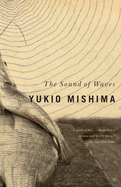
The Sound of Waves, Yukio Mishima
Vintage International (Random House), 183 pages, 1954, translated by Meredith Weatherby in 1956
After The Sailor Who Fell from Grace with the Sea, reading a Mishima novel where both the hero and heroine are good, simple people and virtue triumphs over evil in the end was... strange, to say the least. I really enjoyed it, though! The writing is beautiful and it's full of all the now-familiar little details about Japanese village life (visiting the local shrine, meeting neighbors at the public bath, junior high school kids going on the yearly trip to Kyoto).
Next up: East of Eden by John Steinbeck
Subscribe to:
Posts (Atom)