Notes from Underground, Fyodor Dostoevsky
Bantam Books, 153 pages, 1864, translated by Mirra Ginsburg in 1974
I put off reading this forever and ever and ever because of Dostoevsky's reputation as a dense, difficult, cerebral novelist, but finally the book challenge forced me to give in because it was one of the few short books I had left to read and now I wonder what took me so long.
I swear to God I read somewhere that the Beat Generation was heavily influenced by Notes from Underground, and now I can't find any reference to it, which is too bad because reading it gave me a new way of approaching the main question I had about On the Road: if Jack Kerouac honestly believes in the Beat way of life (as he seems to), why does it come across as so repugnant? (Or, since he's apparently self-aware enough to realize how destructive it is, why does he believe so fervently in it?) At the time I read it I came to the conclusion that he was just painting a picture of the Beat Generation in the entirety of its glory and despair. In Notes from Underground, though, the underground man prioritizes freedom and self-expression over happiness and well-being, saying that "man, whoever he might be, has always and everywhere preferred to act according to his own wishes rather than according to the dictates of reason and advantage." He goes on to portray base, random, irrational acts as a sort of rebellion against 18th-century ideas of human nature as essentially good and rational, saying that "though [human nature] may be wrong, it's nevertheless alive." I think this is what On the Road is getting at--freedom at any cost; putting authenticity and ecstasy and experience above stability and order and well-being.
(This is not all I got out of Notes from Underground, by the way--it's just the only thing I can say that somebody else hasn't already said better.)
Showing posts with label books in translation. Show all posts
12.28.2011
12.27.2011
42. The Lake
The Lake, Banana Yoshimoto
Melville House, 188 pages, 2005, translated by Michael Emmerich in 2011
It's probably a function of language or translation or some combination of the two, but all the modern Japanese authors I've read--Haruki Murakami, Yoko Ogawa, Banana Yoshimoto, to some extent even Mishima--share certain qualities of style: extreme care and attention in describing discrete physical objects (a carton of milk in Murakami's Kafka on the Shore, grapefruit jelly in Ogawa's Pregnancy Diary, a wire grilling rack in The Lake), combined with a certain vagueness of feeling, told in a voice characterized by colloquialism and familiarity and a very Japanese measure of ambivalence (lots of "you know" and "well, I" and "that's just the way I feel"). I really love this style and it's probably part of why I can read any of the above authors writing about any damn old thing.
The Lake centers around the relationship between optimistic artist Chihiro and oddball grad student Nakajima. Chihiro is strong and independent, but in facing her mother's death comes to realize that she is still in a way trying to escape the small town she grew up in; she enters a tentative relationship with Nakajima, supporting him through his attempt to overcome childhood trauma. I wouldn't call it a brilliant plot--although Nakajima constantly alludes to a terrible secret that is revealed near the end of the book, nothing ever really happens--but Chihiro's inner world is so rich and detailed that there's always something to come back to, something more to explore and ponder. After this book I'm looking forward to reading more Banana Yoshimoto!
Melville House, 188 pages, 2005, translated by Michael Emmerich in 2011
It's probably a function of language or translation or some combination of the two, but all the modern Japanese authors I've read--Haruki Murakami, Yoko Ogawa, Banana Yoshimoto, to some extent even Mishima--share certain qualities of style: extreme care and attention in describing discrete physical objects (a carton of milk in Murakami's Kafka on the Shore, grapefruit jelly in Ogawa's Pregnancy Diary, a wire grilling rack in The Lake), combined with a certain vagueness of feeling, told in a voice characterized by colloquialism and familiarity and a very Japanese measure of ambivalence (lots of "you know" and "well, I" and "that's just the way I feel"). I really love this style and it's probably part of why I can read any of the above authors writing about any damn old thing.
The Lake centers around the relationship between optimistic artist Chihiro and oddball grad student Nakajima. Chihiro is strong and independent, but in facing her mother's death comes to realize that she is still in a way trying to escape the small town she grew up in; she enters a tentative relationship with Nakajima, supporting him through his attempt to overcome childhood trauma. I wouldn't call it a brilliant plot--although Nakajima constantly alludes to a terrible secret that is revealed near the end of the book, nothing ever really happens--but Chihiro's inner world is so rich and detailed that there's always something to come back to, something more to explore and ponder. After this book I'm looking forward to reading more Banana Yoshimoto!
12.12.2011
35. Island Beneath the Sea
Island Beneath the Sea, Isabel Allende
HarperCollins ebook, 419 pages, 2010, translated by Margaret Sayers Peden
Reading Isabel Allende these days is like, I don't know, going to your favorite restaurant and ordering the steak with fries instead of trying out the hip new Ethiopian place*. It's boring (if satisfying); you already know exactly what you're going to get, which in this case is an enormous cast of characters who evolve slowly and aimlessly over a long period of time, sumptuous descriptions of gowns and French meals and ballrooms, beautiful courtesans, honorable soldiers, and a little bit of political unrest. In that sense it was fine, but the problem was that I actually actively disliked all the characters, except the relatively minor Sancho, and maybe (if pressed) Maurice. It was a little disappointing overall, but I'll probably still read whatever she comes out with next.
*If your immediate, instinctive response to this is "HURF DURF I DIDN'T KNOW THEY EVEN HAD FOOD IN ETHIOPIA," please re-evaluate your life
HarperCollins ebook, 419 pages, 2010, translated by Margaret Sayers Peden
Reading Isabel Allende these days is like, I don't know, going to your favorite restaurant and ordering the steak with fries instead of trying out the hip new Ethiopian place*. It's boring (if satisfying); you already know exactly what you're going to get, which in this case is an enormous cast of characters who evolve slowly and aimlessly over a long period of time, sumptuous descriptions of gowns and French meals and ballrooms, beautiful courtesans, honorable soldiers, and a little bit of political unrest. In that sense it was fine, but the problem was that I actually actively disliked all the characters, except the relatively minor Sancho, and maybe (if pressed) Maurice. It was a little disappointing overall, but I'll probably still read whatever she comes out with next.
*If your immediate, instinctive response to this is "HURF DURF I DIDN'T KNOW THEY EVEN HAD FOOD IN ETHIOPIA," please re-evaluate your life
9.26.2011
31. The Girl with the Dragon Tattoo
The Girl with the Dragon Tattoo, Steig Larsson
Borzoi ebook (Random House), 547 pages, 2005, translated by Reg Keeland in 2008
Yeah, I finally read this, and while I think I liked it overall I'm also kind of ambivalent about it. The nice thing about this book is that it has enough different storylines going on that at least some of it will probably interest every reader. I LOVED the media face-off between journalist Mikael Blomkvist and financier Wennerstrom, and I also enjoyed the mystery of the Vanger family and the descriptions of Blomkvist's life and research in Hedestad. On the other hand, I found Lisbeth Salander, the titular "girl with the dragon tattoo," annoying at best. She was fantastic in the few scenes that showed her in her professional capacity as a private investigator, but the rest of the time it was just this "oh, she's so damaged and promiscuous" act and that got old really fast. A lot has been made of the author's supposed crusade against violence against women, but I really didn't like all the descriptions of rapes and murders--they were completely gratuitous and didn't actually say anything about the issue. And the vigilante justice scene with Salander bugged me--there was something similar in The Time Traveler's Wife (although that was even worse because it was Clare's boyfriend going to kick the rapist's ass--really?), and it's just such a pointless male fantasy. So yeah, I would have been a lot happier if the book centered around Blomkvist, but I'll probably still read the next book in the series. Eventually. Maybe.
Up next: The Blue Castle by L.M. Montgomery
Borzoi ebook (Random House), 547 pages, 2005, translated by Reg Keeland in 2008
Yeah, I finally read this, and while I think I liked it overall I'm also kind of ambivalent about it. The nice thing about this book is that it has enough different storylines going on that at least some of it will probably interest every reader. I LOVED the media face-off between journalist Mikael Blomkvist and financier Wennerstrom, and I also enjoyed the mystery of the Vanger family and the descriptions of Blomkvist's life and research in Hedestad. On the other hand, I found Lisbeth Salander, the titular "girl with the dragon tattoo," annoying at best. She was fantastic in the few scenes that showed her in her professional capacity as a private investigator, but the rest of the time it was just this "oh, she's so damaged and promiscuous" act and that got old really fast. A lot has been made of the author's supposed crusade against violence against women, but I really didn't like all the descriptions of rapes and murders--they were completely gratuitous and didn't actually say anything about the issue. And the vigilante justice scene with Salander bugged me--there was something similar in The Time Traveler's Wife (although that was even worse because it was Clare's boyfriend going to kick the rapist's ass--really?), and it's just such a pointless male fantasy. So yeah, I would have been a lot happier if the book centered around Blomkvist, but I'll probably still read the next book in the series. Eventually. Maybe.
Up next: The Blue Castle by L.M. Montgomery
7.01.2011
18. F. Scott Fitzgerald: This Side of Paradise and 19. Yukio Mishima: The Sound of Waves
Vintage (Random House), 264 pages, 1920
I read this as a pretentious 15-year-old and fully expected it to have failed the test of time eight years later. The only reason I wanted to read it again was because I was reading a biography of legendary Scribner editor Max Perkins before coming to Japan (which I never finished--might try to bring it back with me when I go on my trip home), and this was the novel that launched Perkins's (and Fitzgerald's) career. While rereading it I remembered how much it once meant to me, and discovered that even after college, the coming-of-age story of a self-absorbed, lazy, self-styled intellectual at Princeton wasn't half bad. I think I considered myself a female version of protagonist Amory Blaine when I first read it, and I want to be able to look back and say "Oh God, I was so full of it," but I kind of can't help but admire my teenage self for managing to be so damn earnest about this whole literature thing back when intellect was not considered a desirable trait by my peer group and Thursday Night Market was the closest thing to culture there was in town.
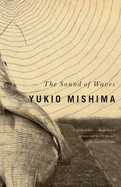
The Sound of Waves, Yukio Mishima
Vintage International (Random House), 183 pages, 1954, translated by Meredith Weatherby in 1956
After The Sailor Who Fell from Grace with the Sea, reading a Mishima novel where both the hero and heroine are good, simple people and virtue triumphs over evil in the end was... strange, to say the least. I really enjoyed it, though! The writing is beautiful and it's full of all the now-familiar little details about Japanese village life (visiting the local shrine, meeting neighbors at the public bath, junior high school kids going on the yearly trip to Kyoto).
Next up: East of Eden by John Steinbeck
6.17.2011
17. Paulo Coehlo: The Alchemist
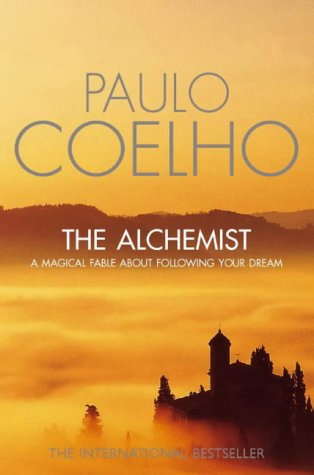
The Alchemist, Paulo Coelho
Harper UK (HarperCollins), 177 pages, 1988, translated by Alan R. Clarke in 1992
A while ago I was obsessed with asking people on Omegle to tell me their favorite book. 9 out of 10 people responded with some variation of "u r gay," and except for one, all of the rest said Twilight. The last person recommended The Alchemist.
So yeah, it's slightly above the intellectual standard of Twilight, but not by much. I can see why it became a bestseller, and it does have its moments, but I don't really have any patience for the kind of vague pseudo-spiritual mumbo-jumbo it puts forth. I got fed up with it around the time Fatima appeared--nothing annoys me like a cardboard cutout love interest (whose love story with the hero is nevertheless supposed to be somehow significant) in a story where all the men are running around dealing with Important Life Questions. Bitch, please. C-- would not buy again
Next up: This Side of Paradise by F. Scott Fitzgerald
Harper UK (HarperCollins), 177 pages, 1988, translated by Alan R. Clarke in 1992
A while ago I was obsessed with asking people on Omegle to tell me their favorite book. 9 out of 10 people responded with some variation of "u r gay," and except for one, all of the rest said Twilight. The last person recommended The Alchemist.
So yeah, it's slightly above the intellectual standard of Twilight, but not by much. I can see why it became a bestseller, and it does have its moments, but I don't really have any patience for the kind of vague pseudo-spiritual mumbo-jumbo it puts forth. I got fed up with it around the time Fatima appeared--nothing annoys me like a cardboard cutout love interest (whose love story with the hero is nevertheless supposed to be somehow significant) in a story where all the men are running around dealing with Important Life Questions. Bitch, please. C-- would not buy again
Next up: This Side of Paradise by F. Scott Fitzgerald
5.30.2011
Book challenge progress
It's been a while, and there's too much to say, and much of it has already been said. (Last year brought two major relocations and the end of a five-year relationship, but after the earthquake and its physical and emotional aftermath, I think I can safely say that this year has already equaled it in insanity. Then there was that date I went on)
Anyway, as usual, the only way I feel like I can dive back into blogging is by talking about books. I'm still behind on the 50-book challenge (I've read 15 books when I should be at around 20), and even more behind with the blogging, and some of these books deserve much more attention than I've given them here, but if I try to do an individual entry for each book I'll never get this done.
6. Lady Chatterley's Lover, D.H. Lawrence
Penguin Books, 314 pages, 1928
I was quite disappointed by this, to be honest. I hadn't expected that the controversy would stand the test of time, but I didn't expect it to be downright sexually conservative, either. I did find the social commentary and anti-industrialist themes interesting--more interesting than the characters, to be honest, which is probably why I didn't enjoy the book. (Apparently it's been criticized in the past for being too transparent in its social commentary, at the expense of storytelling.)
7. Revolutionary Road, Richard Yates
Vintage Classics UK (Random House), 337 pages, 1961
This book works quite well into the post I'm writing about Rabbit, Run by John Updike, so I won't say anything about it here except that it is very nearly the perfect novel.
8. The Book of Tea, Kakuro Okazawa
IBC Publishing, 135 pages, 1906
I started taking lessons on tea ceremony recently, and decided to read this as a way of immersing myself deeper into the meaning and spirit behind tea ceremony. The book easily delivered on that promise and really brought the ceremony alive for me, with the unexpected side effect of making me understand finally this aspect of Japanese culture that I have been rejecting for all these years as cliche. I'm a little ashamed to admit that despite all my Asian American studies coursework, I once had a tendency to thoughtlessly consider the Japanese cultural arts (tea ceremony included) to be sort of outdated and inauthentic, something white people tried to push on me without understanding that Japanese America has long since moved on. But after learning and reading about tea ceremony I understand exactly why the Issei generation continued practicing it in the internment camps, and exactly what was lost when subsequent generations abandoned it to become more American. This is all just my personal baggage and doesn't necessarily have anything to do with the book itself, but it is a wonderful introduction to the philosophy of tea ceremony.
9. Let the Great World Spin, Colum McCann
Random House, 349 pages, 2009
This one took a while to draw me in--I didn't find the initial group of characters especially compelling. But gradually McCann brings in more characters and sketches out the connections between them, creating an intricate web of incidental attachments and people passing in the streets. After those slow first pages, it's a wonderful story.
10. What I Talk About When I Talk About Running, Haruki Murakami
Vintage International (Random House), 180 pages, 2007, translated in 2008 by Philip Gabriel
When I picked this up, it had been a while since I had read anything; instead, I had been spending a lot of time at the gym, and I thought this book would be a good way to connect all that physical effort back to something mental. I love Murakami's style and would enjoy reading him write about just about anything, but what impressed me with this one was how well he knows himself, how intimate and concrete is his knowledge of his own strengths and shortcomings.
11. Life of Pi, Yann Martel
Vintage Canada (Random House), 354 pages, 2001
Life of Pi is just excellent storytelling--funny, sad, smart. I don't know what else to say about it; I avoided reading it for years because of all the buzz and finally became interested in it due to this (really old, major-spoiler-containing) Ask Metafilter thread. It has its flaws, which this review does a better job of describing than I could--the one that bothered me the most was that Pi's religious fervor, so important in the early chapters of the novel, is almost completely dropped as a theme once the survival story begins. But it was still a thoroughly enjoyable read.
12. A Wild Sheep Chase, Haruki Murakami
Vintage UK (Random House), 299 pages, 1982, translated by Alfred Birnbaum
I LOVED, LOVED, LOVED this and I can't even explain why. Like I said, I love Murakami's style and would read him writing about almost anything, but this time it was the story that captivated me--following the nameless protagonist deep into the desolation of northern Hokkaido, passing through sad hotels and forgotten train stations, all in pursuit of a magical sheep. It's like the protagonist says to the black-suited secretary who sends him on the assignment: "This all has got to be, patently, the most unbelievable, the most ridiculous story I have ever heard. Somehow coming from your mouth, it has the ring of truth, but I doubt anyone would believe me if I told them what happened today."
13. The Red Tent, Anita Diamant
Picador USA, 321 pages, 1997
The Red Tent re-imagines the life of a minor female character in the Bible; it's a beautiful, rich, sensory novel. My one problem with it was that after spending the first half of the novel with Dinah's four strong, funny, fascinating mothers, the story of Dinah's exile in Egypt (and her meekness and devotion to her controlling mother-in-law and absent son) is almost disappointing and definitely anti-climactic. Despite that, though, it was a pleasure to read.
I've finished two more books since I started writing this post, but I think I want to give them individual entries. Next up: Rabbit, Run by John Updike
Anyway, as usual, the only way I feel like I can dive back into blogging is by talking about books. I'm still behind on the 50-book challenge (I've read 15 books when I should be at around 20), and even more behind with the blogging, and some of these books deserve much more attention than I've given them here, but if I try to do an individual entry for each book I'll never get this done.
6. Lady Chatterley's Lover, D.H. Lawrence
Penguin Books, 314 pages, 1928
I was quite disappointed by this, to be honest. I hadn't expected that the controversy would stand the test of time, but I didn't expect it to be downright sexually conservative, either. I did find the social commentary and anti-industrialist themes interesting--more interesting than the characters, to be honest, which is probably why I didn't enjoy the book. (Apparently it's been criticized in the past for being too transparent in its social commentary, at the expense of storytelling.)
7. Revolutionary Road, Richard Yates
Vintage Classics UK (Random House), 337 pages, 1961
This book works quite well into the post I'm writing about Rabbit, Run by John Updike, so I won't say anything about it here except that it is very nearly the perfect novel.
8. The Book of Tea, Kakuro Okazawa
IBC Publishing, 135 pages, 1906
I started taking lessons on tea ceremony recently, and decided to read this as a way of immersing myself deeper into the meaning and spirit behind tea ceremony. The book easily delivered on that promise and really brought the ceremony alive for me, with the unexpected side effect of making me understand finally this aspect of Japanese culture that I have been rejecting for all these years as cliche. I'm a little ashamed to admit that despite all my Asian American studies coursework, I once had a tendency to thoughtlessly consider the Japanese cultural arts (tea ceremony included) to be sort of outdated and inauthentic, something white people tried to push on me without understanding that Japanese America has long since moved on. But after learning and reading about tea ceremony I understand exactly why the Issei generation continued practicing it in the internment camps, and exactly what was lost when subsequent generations abandoned it to become more American. This is all just my personal baggage and doesn't necessarily have anything to do with the book itself, but it is a wonderful introduction to the philosophy of tea ceremony.
9. Let the Great World Spin, Colum McCann
Random House, 349 pages, 2009
This one took a while to draw me in--I didn't find the initial group of characters especially compelling. But gradually McCann brings in more characters and sketches out the connections between them, creating an intricate web of incidental attachments and people passing in the streets. After those slow first pages, it's a wonderful story.
10. What I Talk About When I Talk About Running, Haruki Murakami
Vintage International (Random House), 180 pages, 2007, translated in 2008 by Philip Gabriel
When I picked this up, it had been a while since I had read anything; instead, I had been spending a lot of time at the gym, and I thought this book would be a good way to connect all that physical effort back to something mental. I love Murakami's style and would enjoy reading him write about just about anything, but what impressed me with this one was how well he knows himself, how intimate and concrete is his knowledge of his own strengths and shortcomings.
11. Life of Pi, Yann Martel
Vintage Canada (Random House), 354 pages, 2001
Life of Pi is just excellent storytelling--funny, sad, smart. I don't know what else to say about it; I avoided reading it for years because of all the buzz and finally became interested in it due to this (really old, major-spoiler-containing) Ask Metafilter thread. It has its flaws, which this review does a better job of describing than I could--the one that bothered me the most was that Pi's religious fervor, so important in the early chapters of the novel, is almost completely dropped as a theme once the survival story begins. But it was still a thoroughly enjoyable read.
12. A Wild Sheep Chase, Haruki Murakami
Vintage UK (Random House), 299 pages, 1982, translated by Alfred Birnbaum
I LOVED, LOVED, LOVED this and I can't even explain why. Like I said, I love Murakami's style and would read him writing about almost anything, but this time it was the story that captivated me--following the nameless protagonist deep into the desolation of northern Hokkaido, passing through sad hotels and forgotten train stations, all in pursuit of a magical sheep. It's like the protagonist says to the black-suited secretary who sends him on the assignment: "This all has got to be, patently, the most unbelievable, the most ridiculous story I have ever heard. Somehow coming from your mouth, it has the ring of truth, but I doubt anyone would believe me if I told them what happened today."
13. The Red Tent, Anita Diamant
Picador USA, 321 pages, 1997
The Red Tent re-imagines the life of a minor female character in the Bible; it's a beautiful, rich, sensory novel. My one problem with it was that after spending the first half of the novel with Dinah's four strong, funny, fascinating mothers, the story of Dinah's exile in Egypt (and her meekness and devotion to her controlling mother-in-law and absent son) is almost disappointing and definitely anti-climactic. Despite that, though, it was a pleasure to read.
I've finished two more books since I started writing this post, but I think I want to give them individual entries. Next up: Rabbit, Run by John Updike
2.07.2011
3. Yasunari Kawabata: Snow Country
Snow Country, Yasunari Kawabata
Vintage International, 192 pgs., 1947, translated by Edward G. Seidensticker in 1957You want to hear about snow country? Let me tell you about snow country. You know, in case you were wondering whether I was qualified to review a book about wasted effort and lots and lots of snow:
(all taken from the front of my house)
Now that that's out of the way, Snow Country. I'll be honest; I didn't like it. This was the book club book for January, and I also know a few other people around here who have read it in English, and all of us have the same opinion: something was definitely lost in translation. It's about the relationship between a geisha and a visiting Tokyo urbanite in Niigata Prefecture in the 1930s, and it was one of three novels for which Kawabata won the Nobel Prize, which I think is the reason none of us have just dismissed it outright. Not only is it critically acclaimed, it's also about the little corner of the world that we've chosen to call home. We want so badly to be proud of it, like we are of our sake and our rice and our Kenshin, but I just couldn't make myself like it. There are some beautiful images contained within it, but the story left me cold.
(See what I did there?)
In his Nobel Prize acceptance speech, Kawabata says this:
Yet in the sad, austere, autumnal qualities so valued by the tea ceremony, itself summarized in the expression "gently respectful, cleanly quiet", there lies concealed a great richness of spirit; and the tea room, so rigidly confined and simple, contains boundless space and unlimited elegance.Kawabata's writing was heavily influenced by haiku poetry, which I think also shares the qualities which he here associates with tea ceremony--wabi-sabi, mono no aware, all those Japanese cultural ideals that have to do with transience and imperfection. I haven't spent much time reading or learning about haiku, but when I have read them (and other forms of Japanese poetry like the waka of the Kokinshu--all in translation, of course), I've generally found them to be pretty accessible, and I'm totally down with the idea of wabi-sabi.
Yet I still couldn't get into this. I think when it comes down to it, I just didn't find the characters compelling enough to invest the time and energy into exploring the book's relationship to haiku, which seems to be its main redeeming factor. The chronology of events was difficult to follow. I don't know a whole lot about geisha culture, which I'm sure impeded my understanding of the book. It was originally published in serial form, and parts of it were written much later than others, which gave it a choppy, non-continuous feel.
I have a hard time accepting cultural relativism in literature. A lot of people who read Snow Country in English seem to explain its impermeability by saying that it's just "too Japanese" to be accessible to the Western reader, but I hate that, and not just because it reeks of orientalism--I want to believe that if it's art, that it will resonate with the human experience no matter who you are or what time and place you come from. Maybe that's silly--I haven't read a whole lot outside of the Western tradition, and I don't have the energy or the desire to really spend a lot of time trying to find redeeming qualities in books that don't speak to me when there is so much else out there to read, so I may never find out whether it's a cultural divide or my own laziness that's the cause. I can say that I found The Sailor Who Fell from Grace with the Sea much more compelling, even though I didn't like its characters, either; the writing was much more consistent and I found the story absorbing in spite of myself.
Anyway, womp womp, can't like them all. I finished this quite some time ago and I've actually finished two other books since then, so those entries are coming up, I promise!
Next up: Guns, Germs, and Steel by Jared Diamond
1.05.2011
1. Yukio Mishima: The Sailor Who Fell from Grace with the Sea
The Sailor Who Fell from Grace with the Sea, Yukio Mishima
Tuttle, 181 pgs., 1963, translated by John Nathan in 1965
Before I start here I feel compelled to mention (because SOMEONE will throw a fit if I don't) that although I started reading this book in 2010, I didn't pick it up the whole week I was in Tokyo. By the time the trip was over I had lost the thread of the story (not to mention any hope of understanding anything deeper), so I began again from the first page yesterday and finished it the same day. I officially read the whole book in 2011, so I don't want to hear any more whining that I'm cheating. Better step up your game, bitches.
That said, my goal this year is to not only read a lot, but also to retain what I've read. There are so many great books that have passed through me like sand simply because I read them and then put them back on the shelf without a second thought. For me it takes thinking, rereading, supplementary materials, writing, and discussion to fully digest a book, so I'm hoping to blog all the books I read this year to get used to thinking about literature. I'm rusty--I've been out of school for a year, and I haven't taken a good literature class since I was 18. But I'm hoping that this will force me to have something smart to say about each book I read this year, and that, like a muscle, the ability will grow with repeated use.
If we're going to extend the metaphor, though, picking The Sailor Who Fell from Grace with the Sea for my first book of 2011 is like running a marathon without training. It's not Finnegan's Wake, but I found it pretty damn inaccessible in parts. The back cover text alludes to Mishima's belief that Japan "will only become truly great once more when she forcibly purges herself of all Western influence." Without reading that, I could have taken the book as an isolated tale of disillusionment and insanity, but that blurb taunted me into trying to discover an allegory in the characters' lives (which is an interesting comment on how the cover material influences how we experience a book). Part of the problem is that I can't find any information on Mishima's nationalist views. According to his Wikipedia entry, he was strongly influenced by Western literature--so did he only resent Western military influence as opposed to cultural influence, or was he just a contradictory figure?
The book centers around the relationship between Noboru, a 13-year-old boy; his mother, Fusako; and Ryuji, Fusako's lover and the titular sailor. Fusako clearly stands for Western influence--she runs an upscale import clothing shop, and has Ryuji wear expensive Western suits and take English conversation lessons so that he can take over the business. And the sailor Ryuji would be Japan, caught between his seafaring life and vague notions of future "glory" on one side, and a domesticated life on shore with Fusako on the other. It's with Noboru that the allegory idea begins to break down for me--as the character who takes it upon himself to restore Ryuji to his former heroism, he would be the character most strongly identified with Mishima's own views, but he and his gang are deliberately presented as childish, and the gang's chief in particular is both completely insane and strangely helpless, his insanity the obvious result of his parents' neglect. All of the characters, in fact, come off as pathetic, which is why I want to read it as a tale of social decay and not an expression of Mishima's political views.
The prose is beautiful, and the book is quite short, though it's too disturbing to be described as an easy read. I bought another Mishima book, The Sound of Waves, when I was in Tokyo--it sounds quite different from this one, and I'm excited to read it.
Next up: Room by Emma Donoghue
Tuttle, 181 pgs., 1963, translated by John Nathan in 1965
Before I start here I feel compelled to mention (because SOMEONE will throw a fit if I don't) that although I started reading this book in 2010, I didn't pick it up the whole week I was in Tokyo. By the time the trip was over I had lost the thread of the story (not to mention any hope of understanding anything deeper), so I began again from the first page yesterday and finished it the same day. I officially read the whole book in 2011, so I don't want to hear any more whining that I'm cheating. Better step up your game, bitches.
That said, my goal this year is to not only read a lot, but also to retain what I've read. There are so many great books that have passed through me like sand simply because I read them and then put them back on the shelf without a second thought. For me it takes thinking, rereading, supplementary materials, writing, and discussion to fully digest a book, so I'm hoping to blog all the books I read this year to get used to thinking about literature. I'm rusty--I've been out of school for a year, and I haven't taken a good literature class since I was 18. But I'm hoping that this will force me to have something smart to say about each book I read this year, and that, like a muscle, the ability will grow with repeated use.
If we're going to extend the metaphor, though, picking The Sailor Who Fell from Grace with the Sea for my first book of 2011 is like running a marathon without training. It's not Finnegan's Wake, but I found it pretty damn inaccessible in parts. The back cover text alludes to Mishima's belief that Japan "will only become truly great once more when she forcibly purges herself of all Western influence." Without reading that, I could have taken the book as an isolated tale of disillusionment and insanity, but that blurb taunted me into trying to discover an allegory in the characters' lives (which is an interesting comment on how the cover material influences how we experience a book). Part of the problem is that I can't find any information on Mishima's nationalist views. According to his Wikipedia entry, he was strongly influenced by Western literature--so did he only resent Western military influence as opposed to cultural influence, or was he just a contradictory figure?
The book centers around the relationship between Noboru, a 13-year-old boy; his mother, Fusako; and Ryuji, Fusako's lover and the titular sailor. Fusako clearly stands for Western influence--she runs an upscale import clothing shop, and has Ryuji wear expensive Western suits and take English conversation lessons so that he can take over the business. And the sailor Ryuji would be Japan, caught between his seafaring life and vague notions of future "glory" on one side, and a domesticated life on shore with Fusako on the other. It's with Noboru that the allegory idea begins to break down for me--as the character who takes it upon himself to restore Ryuji to his former heroism, he would be the character most strongly identified with Mishima's own views, but he and his gang are deliberately presented as childish, and the gang's chief in particular is both completely insane and strangely helpless, his insanity the obvious result of his parents' neglect. All of the characters, in fact, come off as pathetic, which is why I want to read it as a tale of social decay and not an expression of Mishima's political views.
The prose is beautiful, and the book is quite short, though it's too disturbing to be described as an easy read. I bought another Mishima book, The Sound of Waves, when I was in Tokyo--it sounds quite different from this one, and I'm excited to read it.
Next up: Room by Emma Donoghue
Subscribe to:
Posts (Atom)