Showing posts with label bestsellers. Show all posts

1.06.2012

49. Fahrenheit 451

Fahrenheit 451, Ray Bradbury
Del Rey (Ballantine), 1953, 179 pages

I read this when I was in the 10th grade, and revisiting it was kind of a bummer, because it just wasn't that good. (Well, it did win the National Book Award.) I've always remembered it as one of the best books I was required to read in high school. I can see exactly why it appealed to my 15-year-old self--ornate, overblown language that I considered literary and a clear message that was delivered largely in impassioned speeches by various characters--and those are exactly the reasons I dislike it now. The plot is flimsy, the characters one-dimensional, and the author clearly has an axe to grind. Bradbury also rants (in the book itself and in his various afterwords) about the tyranny of minorities and how objections to works of literature on the grounds of racial/gender/religious sensitivity will be the downfall of aesthetics and society. Which is, you know, real cute, but off-putting. He refers to "women's libbers" in a supplementary interview (also included in the book) that was conducted in 2003, which is just plain embarrassing. The "women's libbers" have a point: the only roles women play in this book are brainwashed wife (Mildred) or non-threatening catalyst (sort of a muse) for the male character's important revelations (Clarisse). I found it especially striking that the nomads at the end of the book, the ones who have memorized various works of literature and now represent the repository of human knowledge in the book-burning era, are all specifically referred to as men. Perhaps Bradbury thought that a mixed-gender nomad camp would provide too many distractions.

A funny side note: For quite a while, in my support for ebooks as a medium, I had in the back of my mind a moment in Fahrenheit 451 where Faber tells Montag that it's the message that matters, not the medium, and that in fact even the TV parlors could serve the same purpose as literature if they would project "the same infinite detail and awareness." Turns out that Bradbury has refused to allow ebook versions of his books for years, and has only in the past year or so been forced into accepting an ebook deal with the realization that no publisher would renew his print contract without an ebook component. I have as much fondness for the physical components of a book as anyone, and I do think there's a debate to be had about what modern technology has done to our attention spans, but I find most arguments against ebooks to be hopelessly sentimental. A book is so much more than just paper and ink and glue.

12.21.2011

40. Mockingjay

Mockingjay, Suzanne Collins
Scholastic Press e-book, 288 pages, 2010

Maryann and I had a conversation the other day that clarified my thoughts on the Hunger Games trilogy as a whole, and what I thought was its major flaw: Katniss doesn't change or grow as a character at all throughout the books. She's portrayed as kind of an unlikable personality to begin with--surly, distrustful, far less crowd-pleasing than the kind and honest Peeta--and it works in the first book when she's fighting for survival and sacrificing herself to save her sister. But in the second and third books she remains completely self-centered as the struggle she's caught up in grows bigger and bigger around her, and it's frustrating.

I disagree with Maryann on the ending; I think Katniss ended up with the right guy (trying not to spoil things here although you probably shouldn't be reading this anyway if you haven't read the book and want to). I disliked what they did with Peeta through most of the book, and I think the final chapters had a kind of Harry Potter and the Deathly Hallows bloodbath thing going on where characters were killed seemingly at random and their deaths were barely noticed (spoilers, highlight to read: FINNICK!!!!!! Plot-wise there was NO reason he had to die, except that he was a newlywed and that's apparently the rule in these situations. Bonus cheap drama points if his wife is pregnant. How boring and predictable.) But honestly, all this is just nitpicking the most enjoyable series I've read in quite a while. Still highly recommended.

12.12.2011

35. Island Beneath the Sea

Island Beneath the Sea, Isabel Allende
HarperCollins ebook, 419 pages, 2010, translated by Margaret Sayers Peden

Reading Isabel Allende these days is like, I don't know, going to your favorite restaurant and ordering the steak with fries instead of trying out the hip new Ethiopian place*. It's boring (if satisfying); you already know exactly what you're going to get, which in this case is an enormous cast of characters who evolve slowly and aimlessly over a long period of time, sumptuous descriptions of gowns and French meals and ballrooms, beautiful courtesans, honorable soldiers, and a little bit of political unrest. In that sense it was fine, but the problem was that I actually actively disliked all the characters, except the relatively minor Sancho, and maybe (if pressed) Maurice. It was a little disappointing overall, but I'll probably still read whatever she comes out with next.

*If your immediate, instinctive response to this is "HURF DURF I DIDN'T KNOW THEY EVEN HAD FOOD IN ETHIOPIA," please re-evaluate your life

9.26.2011

31. The Girl with the Dragon Tattoo

The Girl with the Dragon Tattoo, Steig Larsson
Borzoi ebook (Random House), 547 pages, 2005, translated by Reg Keeland in 2008

Yeah, I finally read this, and while I think I liked it overall I'm also kind of ambivalent about it. The nice thing about this book is that it has enough different storylines going on that at least some of it will probably interest every reader. I LOVED the media face-off between journalist Mikael Blomkvist and financier Wennerstrom, and I also enjoyed the mystery of the Vanger family and the descriptions of Blomkvist's life and research in Hedestad. On the other hand, I found Lisbeth Salander, the titular "girl with the dragon tattoo," annoying at best. She was fantastic in the few scenes that showed her in her professional capacity as a private investigator, but the rest of the time it was just this "oh, she's so damaged and promiscuous" act and that got old really fast. A lot has been made of the author's supposed crusade against violence against women, but I really didn't like all the descriptions of rapes and murders--they were completely gratuitous and didn't actually say anything about the issue. And the vigilante justice scene with Salander bugged me--there was something similar in The Time Traveler's Wife (although that was even worse because it was Clare's boyfriend going to kick the rapist's ass--really?), and it's just such a pointless male fantasy. So yeah, I would have been a lot happier if the book centered around Blomkvist, but I'll probably still read the next book in the series. Eventually. Maybe.

Up next: The Blue Castle by L.M. Montgomery

9.05.2011

28. Catching Fire

Catching Fire, Suzanne Collins
Scholastic Press, 285 pages, 2009

I've been SO looking forward to reading this ever since I finished The Hunger Games, and it didn't disappoint. I did find the first half of the book less suspenseful than The Hunger Games, since the Games are now over and the story revolves around the victors going on tour and the rebellions that have started in the districts of Panem, but it picked up in the second half for reasons that I can't talk about because it would be a huge spoiler. I don't think I am going to know 100 percent how I feel about this book until I finish reading the third book, to be honest. It did start to seem less like the author had created a complex world and was working within its bounds and more like she was just pulling out all the tricks in the book to create suspense, but shit, it worked.

Next up: Slouching Towards Bethlehem by Joan Didion

8.30.2011

27. The Time Traveler's Wife

The Time Traveler's Wife, Audrey Niffenegger
Vintage UK (Random House), 519 pages, 2004

I hate to say this, because so many of my friends saw me reading this book and told me they LOVED it, were moved to tears by it, etc, but it was just too damn long. For a story with such an interesting premise it sure managed to be boring. The beginning, when we're still putting together the story of Henry's time-travel, was great, but then it devolved into hundreds of pages of wedded suburban humdrum. Now they're shopping for a house! Now Clare wants a baby! Now they're struggling with infertility! If I found this kind of shit interesting I could just re-friend all the people I hated in high school and read my facebook feed. Something about the characters rubbed me the wrong way too--the princess and the bad boy. I didn't think they really showed any chemistry--the only reason they were together was because, well, they were (thanks to Henry time-traveling to meet Clare in her childhood so that neither of them had any choice; it's FATE!!!1). The last time I read a love story this contrived was, no joke, Twilight.

Next up: Catching Fire by Suzanne Collins

8.09.2011

23. The Hunger Games

The Hunger Games, Suzanne Collins
Scholastic ePub edition, 275 pages, 2008


I know you have heard this from everyone and their mom by now but oh my God this was so good. SO GOOD. In case you live under a rock, it's a dystopian YA novel in which one boy and one girl from each of the 12 districts of Panem are selected as "tributes" and forced to participate in a televised battle to the death. This summary was, I'll admit, unappealing to me, but I read it anyway because of the buzz and I am completely won over. The suspense! The action! The romance! Agjsdlkgsfd! It stays far away from any kind of preachiness or political agenda, which I think was a smart move; instead it explores the choices and the sacrifices made by the tributes forced to participate in the brutal Games, all wrapped up in the most exciting adventure I've read since... I don't know, Harry Potter, maybe, but The Hunger Games sucked me in even more than that. I'm dyyyyying to read the next one but I don't want the series to end so I'm forcing myself to space it out. 


Next up: Small Gods by Terry Pratchett

6.17.2011

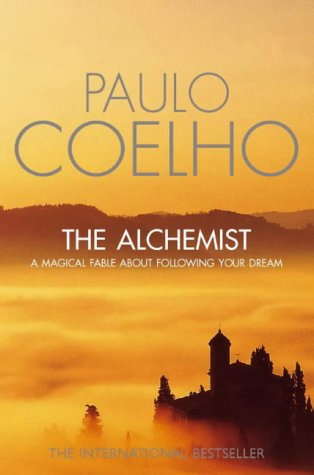
17. Paulo Coehlo: The Alchemist

The Alchemist, Paulo Coelho
Harper UK (HarperCollins), 177 pages, 1988, translated by Alan R. Clarke in 1992

A while ago I was obsessed with asking people on Omegle to tell me their favorite book. 9 out of 10 people responded with some variation of "u r gay," and except for one, all of the rest said Twilight. The last person recommended The Alchemist.

So yeah, it's slightly above the intellectual standard of Twilight, but not by much. I can see why it became a bestseller, and it does have its moments, but I don't really have any patience for the kind of vague pseudo-spiritual mumbo-jumbo it puts forth. I got fed up with it around the time Fatima appeared--nothing annoys me like a cardboard cutout love interest (whose love story with the hero is nevertheless supposed to be somehow significant) in a story where all the men are running around dealing with Important Life Questions. Bitch, please. C-- would not buy again

Next up: This Side of Paradise by F. Scott Fitzgerald

5.30.2011

Book challenge progress

It's been a while, and there's too much to say, and much of it has already been said. (Last year brought two major relocations and the end of a five-year relationship, but after the earthquake and its physical and emotional aftermath, I think I can safely say that this year has already equaled it in insanity. Then there was that date I went on)

Anyway, as usual, the only way I feel like I can dive back into blogging is by talking about books. I'm still behind on the 50-book challenge (I've read 15 books when I should be at around 20), and even more behind with the blogging, and some of these books deserve much more attention than I've given them here, but if I try to do an individual entry for each book I'll never get this done.

6. Lady Chatterley's Lover, D.H. Lawrence
Penguin Books, 314 pages, 1928
I was quite disappointed by this, to be honest. I hadn't expected that the controversy would stand the test of time, but I didn't expect it to be downright sexually conservative, either. I did find the social commentary and anti-industrialist themes interesting--more interesting than the characters, to be honest, which is probably why I didn't enjoy the book. (Apparently it's been criticized in the past for being too transparent in its social commentary, at the expense of storytelling.)

7. Revolutionary Road, Richard Yates
Vintage Classics UK (Random House), 337 pages, 1961
This book works quite well into the post I'm writing about Rabbit, Run by John Updike, so I won't say anything about it here except that it is very nearly the perfect novel.

8. The Book of Tea, Kakuro Okazawa
IBC Publishing, 135 pages, 1906
I started taking lessons on tea ceremony recently, and decided to read this as a way of immersing myself deeper into the meaning and spirit behind tea ceremony. The book easily delivered on that promise and really brought the ceremony alive for me, with the unexpected side effect of making me understand finally this aspect of Japanese culture that I have been rejecting for all these years as cliche. I'm a little ashamed to admit that despite all my Asian American studies coursework, I once had a tendency to thoughtlessly consider the Japanese cultural arts (tea ceremony included) to be sort of outdated and inauthentic, something white people tried to push on me without understanding that Japanese America has long since moved on. But after learning and reading about tea ceremony I understand exactly why the Issei generation continued practicing it in the internment camps, and exactly what was lost when subsequent generations abandoned it to become more American. This is all just my personal baggage and doesn't necessarily have anything to do with the book itself, but it is a wonderful introduction to the philosophy of tea ceremony.

9. Let the Great World Spin, Colum McCann
Random House, 349 pages, 2009
This one took a while to draw me in--I didn't find the initial group of characters especially compelling. But gradually McCann brings in more characters and sketches out the connections between them, creating an intricate web of incidental attachments and people passing in the streets. After those slow first pages, it's a wonderful story.

10. What I Talk About When I Talk About Running, Haruki Murakami
Vintage International (Random House), 180 pages, 2007, translated in 2008 by Philip Gabriel
When I picked this up, it had been a while since I had read anything; instead, I had been spending a lot of time at the gym, and I thought this book would be a good way to connect all that physical effort back to something mental. I love Murakami's style and would enjoy reading him write about just about anything, but what impressed me with this one was how well he knows himself, how intimate and concrete is his knowledge of his own strengths and shortcomings.

11. Life of Pi, Yann Martel
Vintage Canada (Random House), 354 pages, 2001
Life of Pi is just excellent storytelling--funny, sad, smart. I don't know what else to say about it; I avoided reading it for years because of all the buzz and finally became interested in it due to this (really old, major-spoiler-containing) Ask Metafilter thread. It has its flaws, which this review does a better job of describing than I could--the one that bothered me the most was that Pi's religious fervor, so important in the early chapters of the novel, is almost completely dropped as a theme once the survival story begins. But it was still a thoroughly enjoyable read.

12. A Wild Sheep Chase, Haruki Murakami
Vintage UK (Random House), 299 pages, 1982, translated by Alfred Birnbaum
I LOVED, LOVED, LOVED this and I can't even explain why. Like I said, I love Murakami's style and would read him writing about almost anything, but this time it was the story that captivated me--following the nameless protagonist deep into the desolation of northern Hokkaido, passing through sad hotels and forgotten train stations, all in pursuit of a magical sheep. It's like the protagonist says to the black-suited secretary who sends him on the assignment: "This all has got to be, patently, the most unbelievable, the most ridiculous story I have ever heard. Somehow coming from your mouth, it has the ring of truth, but I doubt anyone would believe me if I told them what happened today."

13. The Red Tent, Anita Diamant
Picador USA, 321 pages, 1997
The Red Tent re-imagines the life of a minor female character in the Bible; it's a beautiful, rich, sensory novel. My one problem with it was that after spending the first half of the novel with Dinah's four strong, funny, fascinating mothers, the story of Dinah's exile in Egypt (and her meekness and devotion to her controlling mother-in-law and absent son) is almost disappointing and definitely anti-climactic. Despite that, though, it was a pleasure to read.

I've finished two more books since I started writing this post, but I think I want to give them individual entries. Next up: Rabbit, Run by John Updike