Showing posts with label recently published. Show all posts

12.27.2011

42. The Lake

The Lake, Banana Yoshimoto
Melville House, 188 pages, 2005, translated by Michael Emmerich in 2011

It's probably a function of language or translation or some combination of the two, but all the modern Japanese authors I've read--Haruki Murakami, Yoko Ogawa, Banana Yoshimoto, to some extent even Mishima--share certain qualities of style: extreme care and attention in describing discrete physical objects (a carton of milk in Murakami's Kafka on the Shore, grapefruit jelly in Ogawa's Pregnancy Diary, a wire grilling rack in The Lake), combined with a certain vagueness of feeling, told in a voice characterized by colloquialism and familiarity and a very Japanese measure of ambivalence (lots of "you know" and "well, I" and "that's just the way I feel"). I really love this style and it's probably part of why I can read any of the above authors writing about any damn old thing.


The Lake centers around the relationship between optimistic artist Chihiro and oddball grad student Nakajima. Chihiro is strong and independent, but in facing her mother's death comes to realize that she is still in a way trying to escape the small town she grew up in; she enters a tentative relationship with Nakajima, supporting him through his attempt to overcome childhood trauma. I wouldn't call it a brilliant plot--although Nakajima constantly alludes to a terrible secret that is revealed near the end of the book, nothing ever really happens--but Chihiro's inner world is so rich and detailed that there's always something to come back to, something more to explore and ponder. After this book I'm looking forward to reading more Banana Yoshimoto!

12.21.2011

40. Mockingjay

Mockingjay, Suzanne Collins
Scholastic Press e-book, 288 pages, 2010

Maryann and I had a conversation the other day that clarified my thoughts on the Hunger Games trilogy as a whole, and what I thought was its major flaw: Katniss doesn't change or grow as a character at all throughout the books. She's portrayed as kind of an unlikable personality to begin with--surly, distrustful, far less crowd-pleasing than the kind and honest Peeta--and it works in the first book when she's fighting for survival and sacrificing herself to save her sister. But in the second and third books she remains completely self-centered as the struggle she's caught up in grows bigger and bigger around her, and it's frustrating.

I disagree with Maryann on the ending; I think Katniss ended up with the right guy (trying not to spoil things here although you probably shouldn't be reading this anyway if you haven't read the book and want to). I disliked what they did with Peeta through most of the book, and I think the final chapters had a kind of Harry Potter and the Deathly Hallows bloodbath thing going on where characters were killed seemingly at random and their deaths were barely noticed (spoilers, highlight to read: FINNICK!!!!!! Plot-wise there was NO reason he had to die, except that he was a newlywed and that's apparently the rule in these situations. Bonus cheap drama points if his wife is pregnant. How boring and predictable.) But honestly, all this is just nitpicking the most enjoyable series I've read in quite a while. Still highly recommended.

12.12.2011

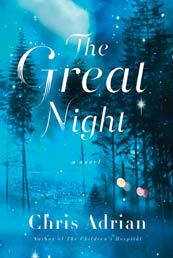
34. The Great Night

The Great Night, Chris Adrian
Farrar, Straus and Giroux ebook, 310 pages, 2011

Holy Shakespeare I am behind on book posts. It's actually been more than a month since I read this now. The Great Night is Adrian's retelling (more of an homage, really) of A Midsummer Night's Dream, set in Buena Vista Park in modern-day San Francisco. Oberon and Titania are recast as supernatural parents who have recently lost their young son to leukemia; the acting troupe becomes a group of homeless people determined to speak out via musical theater about (what they believe is) the mayor's plan to turn the city's homeless into food, and the original play's four lovers are now three heartbroken San Franciscans who become lost in the park on their way to a party. It reminded me a lot of early Francesca Lia Block, after Weetzie Bat but before all the dark confessional stuff, seamlessly and whimsically weaving faeries and magical creatures into a modern-day urban scene--not literary, necessarily, but entertaining and bawdy and a whole lot of fun. On the other hand, my opinion of the book is mixed--I agree with one review (which I can't find now) that said the portrayal of Titania and Oberon as godlike creatures who ultimately cannot prevent or deal with their son's death was by far the best-written and most moving part of the book. The stories of the three human lovers never quite reach a satisfying conclusion, only a threesome.

35. Island Beneath the Sea

Island Beneath the Sea, Isabel Allende
HarperCollins ebook, 419 pages, 2010, translated by Margaret Sayers Peden

Reading Isabel Allende these days is like, I don't know, going to your favorite restaurant and ordering the steak with fries instead of trying out the hip new Ethiopian place*. It's boring (if satisfying); you already know exactly what you're going to get, which in this case is an enormous cast of characters who evolve slowly and aimlessly over a long period of time, sumptuous descriptions of gowns and French meals and ballrooms, beautiful courtesans, honorable soldiers, and a little bit of political unrest. In that sense it was fine, but the problem was that I actually actively disliked all the characters, except the relatively minor Sancho, and maybe (if pressed) Maurice. It was a little disappointing overall, but I'll probably still read whatever she comes out with next.

*If your immediate, instinctive response to this is "HURF DURF I DIDN'T KNOW THEY EVEN HAD FOOD IN ETHIOPIA," please re-evaluate your life

9.26.2011

31. The Girl with the Dragon Tattoo

The Girl with the Dragon Tattoo, Steig Larsson
Borzoi ebook (Random House), 547 pages, 2005, translated by Reg Keeland in 2008

Yeah, I finally read this, and while I think I liked it overall I'm also kind of ambivalent about it. The nice thing about this book is that it has enough different storylines going on that at least some of it will probably interest every reader. I LOVED the media face-off between journalist Mikael Blomkvist and financier Wennerstrom, and I also enjoyed the mystery of the Vanger family and the descriptions of Blomkvist's life and research in Hedestad. On the other hand, I found Lisbeth Salander, the titular "girl with the dragon tattoo," annoying at best. She was fantastic in the few scenes that showed her in her professional capacity as a private investigator, but the rest of the time it was just this "oh, she's so damaged and promiscuous" act and that got old really fast. A lot has been made of the author's supposed crusade against violence against women, but I really didn't like all the descriptions of rapes and murders--they were completely gratuitous and didn't actually say anything about the issue. And the vigilante justice scene with Salander bugged me--there was something similar in The Time Traveler's Wife (although that was even worse because it was Clare's boyfriend going to kick the rapist's ass--really?), and it's just such a pointless male fantasy. So yeah, I would have been a lot happier if the book centered around Blomkvist, but I'll probably still read the next book in the series. Eventually. Maybe.

Up next: The Blue Castle by L.M. Montgomery

1.06.2011

2. Emma Donoghue: Room

Room, Emma Donoghue
Picador, 401 pgs., 2010

I can already tell that the hardest part of this challenge is going to be the blog write-ups. Room is every bit as hard for me to write about as The Sailor Who Fell from Grace with the Sea, though for completely different reasons. It's an easy read, without much to interpret, but my initial reaction to it could be summed up as "Meh." Just as "It's just wrong!" didn't suffice as a grammar explanation when I first began copy editing, though (my writers certainly didn't like it much, anyway), "Meh" won't cut it for a review or in-house memo, especially when many reviewers seem to be raving about the book (it was even shortlisted for the Man Booker Prize). I became a much stronger copy editor when I learned to verbalize why something wasn't working grammatically. Working that muscle.

Room is told through the eyes of Jack, a five-year-old boy who lives with his Ma in a single, locked room. Unlike some of the more negative Amazon reviewers, I wasn't bothered by Jack's childish narrative voice (he talks about "hotting" the thermostat and measuring his "heavy"), but neither was I particularly impressed by it. Nor was I a fan of the constant references to Dora, Spongebob, et al--I suppose it does lend an air of realism to things, but it doesn't seem to serve any real purpose, unlike in the works of say, Lois-Ann Yamanaka, where junk mainland pop culture is a metaphor for the mainstream's cultural domination over Hawaii. The subject matter gives the book some artificial suspense, but so many pages are devoted to Jack and Ma's daily routines in Room that it becomes dull very quickly. I thought the idea behind Room--a young girl abducted and isolated, a boy born and raised in confinement, the bond they form and the readjustment they must go through after their escape--was compelling, but there was so much more the author could have done with it. Overall, disappointing.

I'm about a week ahead of schedule, so I'm going for something slightly more ambitious this time. Next up: Guns, Germs, and Steel by Jared Diamond