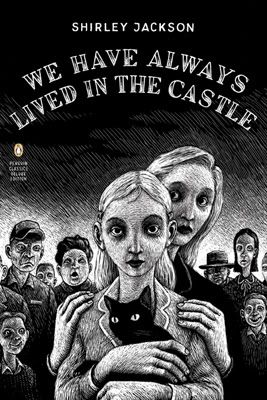
We Have Always Lived in the Castle, Shirley Jackson
Penguin Books, 169 pages, 1962
I kind of think of this as the surprise ending to my book challenge. I bought the ebook edition from Green Apple Books back when I first got my Kindle because someone had recommended it on Ask Metafilter, and then I never got around to reading it until finally I found myself on a train to Hiroshima on December 30 with 49 books read and thought "well hell, this one is only 169 pages long." And it ended up being the most original, atmospheric, and imaginative book I've read all year. The story, about two sisters who live with their uncle in a house outside the village after the rest of their family was poisoned to death, is brilliantly creepy. Constance, the older sister, who was accused of murder after the poisoning but eventually acquitted, is agoraphobic and never ventures beyond the garden, but far more unsettling is her obsession with housework and placid refusal to acknowledge any unpleasantness (of which there is plenty in the Blackwood household). When someone complains about her sister Merricat's antisocial behavior, she smiles and offers them a piece of onion pie. Uncle Julian is obsessed with documenting and solving the murders, and babbles on about the topic to anyone who will listen, far beyond the point of decency. However, it's Merricat, the narrator, who's the most disturbing. Eighteen but childish, she shows a slavish devotion to Constance, but imagines everyone else's deaths in graphic detail for offenses like knocking on the door. Despite her magical protections on the household (which resemble OCD more than anything), the Blackwoods' cousin Charles comes to visit, and that's when everything comes tumbling down. I seriously cannot say enough good things about this book--being inside Merricat's world is terrifying in a completely original way.
1.08.2012
1.06.2012
49. Fahrenheit 451
Fahrenheit 451, Ray Bradbury
Del Rey (Ballantine), 1953, 179 pages
I read this when I was in the 10th grade, and revisiting it was kind of a bummer, because it just wasn't that good. (Well, it did win the National Book Award.) I've always remembered it as one of the best books I was required to read in high school. I can see exactly why it appealed to my 15-year-old self--ornate, overblown language that I considered literary and a clear message that was delivered largely in impassioned speeches by various characters--and those are exactly the reasons I dislike it now. The plot is flimsy, the characters one-dimensional, and the author clearly has an axe to grind. Bradbury also rants (in the book itself and in his various afterwords) about the tyranny of minorities and how objections to works of literature on the grounds of racial/gender/religious sensitivity will be the downfall of aesthetics and society. Which is, you know, real cute, but off-putting. He refers to "women's libbers" in a supplementary interview (also included in the book) that was conducted in 2003, which is just plain embarrassing. The "women's libbers" have a point: the only roles women play in this book are brainwashed wife (Mildred) or non-threatening catalyst (sort of a muse) for the male character's important revelations (Clarisse). I found it especially striking that the nomads at the end of the book, the ones who have memorized various works of literature and now represent the repository of human knowledge in the book-burning era, are all specifically referred to as men. Perhaps Bradbury thought that a mixed-gender nomad camp would provide too many distractions.
A funny side note: For quite a while, in my support for ebooks as a medium, I had in the back of my mind a moment in Fahrenheit 451 where Faber tells Montag that it's the message that matters, not the medium, and that in fact even the TV parlors could serve the same purpose as literature if they would project "the same infinite detail and awareness." Turns out that Bradbury has refused to allow ebook versions of his books for years, and has only in the past year or so been forced into accepting an ebook deal with the realization that no publisher would renew his print contract without an ebook component. I have as much fondness for the physical components of a book as anyone, and I do think there's a debate to be had about what modern technology has done to our attention spans, but I find most arguments against ebooks to be hopelessly sentimental. A book is so much more than just paper and ink and glue.
Del Rey (Ballantine), 1953, 179 pages
I read this when I was in the 10th grade, and revisiting it was kind of a bummer, because it just wasn't that good. (Well, it did win the National Book Award.) I've always remembered it as one of the best books I was required to read in high school. I can see exactly why it appealed to my 15-year-old self--ornate, overblown language that I considered literary and a clear message that was delivered largely in impassioned speeches by various characters--and those are exactly the reasons I dislike it now. The plot is flimsy, the characters one-dimensional, and the author clearly has an axe to grind. Bradbury also rants (in the book itself and in his various afterwords) about the tyranny of minorities and how objections to works of literature on the grounds of racial/gender/religious sensitivity will be the downfall of aesthetics and society. Which is, you know, real cute, but off-putting. He refers to "women's libbers" in a supplementary interview (also included in the book) that was conducted in 2003, which is just plain embarrassing. The "women's libbers" have a point: the only roles women play in this book are brainwashed wife (Mildred) or non-threatening catalyst (sort of a muse) for the male character's important revelations (Clarisse). I found it especially striking that the nomads at the end of the book, the ones who have memorized various works of literature and now represent the repository of human knowledge in the book-burning era, are all specifically referred to as men. Perhaps Bradbury thought that a mixed-gender nomad camp would provide too many distractions.
A funny side note: For quite a while, in my support for ebooks as a medium, I had in the back of my mind a moment in Fahrenheit 451 where Faber tells Montag that it's the message that matters, not the medium, and that in fact even the TV parlors could serve the same purpose as literature if they would project "the same infinite detail and awareness." Turns out that Bradbury has refused to allow ebook versions of his books for years, and has only in the past year or so been forced into accepting an ebook deal with the realization that no publisher would renew his print contract without an ebook component. I have as much fondness for the physical components of a book as anyone, and I do think there's a debate to be had about what modern technology has done to our attention spans, but I find most arguments against ebooks to be hopelessly sentimental. A book is so much more than just paper and ink and glue.
48. Things Fall Apart
Things Fall Apart, Chinua Achebe
Anchor Books, 209 pages, 1959
One funny consequence of my awful procrastination on the 50-book challenge is that to clean up, I ended up reading lots of short but wonderful books that I would never have otherwise gotten around to. Somewhere I had gotten the idea that this book was highbrow, difficult, and maybe a little male-focused (which I tend to find tedious), but it was just the opposite.
Things Fall Apart is a portrait of Ibo tribal life at the end of the 19th century, and Achebe's plain, rhythmic writing style gives it the power of myth. Although parts of the culture portrayed in the book (such as the custom of leaving twins to die in the forest, or the murder of Okonkwo's adopted son, Ikemefuna, on the order of the village oracle) will seem brutal to modern readers no matter what, it's a far cry from Heart of Darkness*, which Achebe was in part responding to and refuting when he wrote his novel. The top review on Amazon says that Achebe gives the wild, "savage" drumbeats in Heart of Darkness a story and a context, which I think is the main function of the novel--the average American has a backwards view of Africa and its people, but Achebe gives us an intimate look at the customs, traditions, personalities, and daily life in one Ibo village. It's also an interesting look at power and how it affects social change--Okonkwo, the village strong man, upholds customs he finds repellent because he is afraid of appearing weak, while those at the bottom of the social food chain who have nothing to lose are the ones who most readily join the Christian missionaries when they come and eventually upset the balance of tribal life.
*Heart of Darkness was saved from earning the title of worst book I was required to read in high school only due to the presence of Lord of the Flies. Dear Folsom Cordova Unified School District, get with the fucking program. Throwing in The Joy Luck Club and calling it a day does not a female minority perspective make.
Anchor Books, 209 pages, 1959
One funny consequence of my awful procrastination on the 50-book challenge is that to clean up, I ended up reading lots of short but wonderful books that I would never have otherwise gotten around to. Somewhere I had gotten the idea that this book was highbrow, difficult, and maybe a little male-focused (which I tend to find tedious), but it was just the opposite.
Things Fall Apart is a portrait of Ibo tribal life at the end of the 19th century, and Achebe's plain, rhythmic writing style gives it the power of myth. Although parts of the culture portrayed in the book (such as the custom of leaving twins to die in the forest, or the murder of Okonkwo's adopted son, Ikemefuna, on the order of the village oracle) will seem brutal to modern readers no matter what, it's a far cry from Heart of Darkness*, which Achebe was in part responding to and refuting when he wrote his novel. The top review on Amazon says that Achebe gives the wild, "savage" drumbeats in Heart of Darkness a story and a context, which I think is the main function of the novel--the average American has a backwards view of Africa and its people, but Achebe gives us an intimate look at the customs, traditions, personalities, and daily life in one Ibo village. It's also an interesting look at power and how it affects social change--Okonkwo, the village strong man, upholds customs he finds repellent because he is afraid of appearing weak, while those at the bottom of the social food chain who have nothing to lose are the ones who most readily join the Christian missionaries when they come and eventually upset the balance of tribal life.
*Heart of Darkness was saved from earning the title of worst book I was required to read in high school only due to the presence of Lord of the Flies. Dear Folsom Cordova Unified School District, get with the fucking program. Throwing in The Joy Luck Club and calling it a day does not a female minority perspective make.
Labels:
1950s,
50-book challenge,
books,
literary fiction,
modern classics
12.28.2011
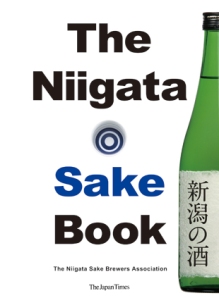
47. The Niigata Sake Book
The Niigata Sake Book, The Niigata Sake Brewers Association
89 pages, The Japan Times, 2008
Oh man, this was SO DISAPPOINTING. My region is supposed to have the best sake in Japan and I've always wanted to learn more about it, how it's made and the different varieties, so I thought this book would be really interesting. But the translation is total crap--the most irritating thing was the constant use of "gracious" as a way to describe sake flavor (dear translators, just because you are translating between two very different languages does not mean you can just make up new meanings for English words whenever you feel like it), but the whole thing was riddled with unclear statements and bizarre adjectives and "Unnecessary Capitalization and Quotation Marks." The writing style is also intolerably dry and technical, and the book is full of more puffed-up nonsense than actual information. I did manage to glean a little bit of knowledge about the brewing process and different sake classifications, but it wasn't anything that's not in the Wikipedia entry for sake, which is better written to boot. This does make me wonder about what's available in English--I think there's definitely a market for a well-written Sake 101 sort of thing.
89 pages, The Japan Times, 2008
Oh man, this was SO DISAPPOINTING. My region is supposed to have the best sake in Japan and I've always wanted to learn more about it, how it's made and the different varieties, so I thought this book would be really interesting. But the translation is total crap--the most irritating thing was the constant use of "gracious" as a way to describe sake flavor (dear translators, just because you are translating between two very different languages does not mean you can just make up new meanings for English words whenever you feel like it), but the whole thing was riddled with unclear statements and bizarre adjectives and "Unnecessary Capitalization and Quotation Marks." The writing style is also intolerably dry and technical, and the book is full of more puffed-up nonsense than actual information. I did manage to glean a little bit of knowledge about the brewing process and different sake classifications, but it wasn't anything that's not in the Wikipedia entry for sake, which is better written to boot. This does make me wonder about what's available in English--I think there's definitely a market for a well-written Sake 101 sort of thing.
Labels:
50-book challenge,
crap,
Japan,
Japanese culture,
non-fiction,
sake
46. Notes from Underground
Notes from Underground, Fyodor Dostoevsky
Bantam Books, 153 pages, 1864, translated by Mirra Ginsburg in 1974
I put off reading this forever and ever and ever because of Dostoevsky's reputation as a dense, difficult, cerebral novelist, but finally the book challenge forced me to give in because it was one of the few short books I had left to read and now I wonder what took me so long.
I swear to God I read somewhere that the Beat Generation was heavily influenced by Notes from Underground, and now I can't find any reference to it, which is too bad because reading it gave me a new way of approaching the main question I had about On the Road: if Jack Kerouac honestly believes in the Beat way of life (as he seems to), why does it come across as so repugnant? (Or, since he's apparently self-aware enough to realize how destructive it is, why does he believe so fervently in it?) At the time I read it I came to the conclusion that he was just painting a picture of the Beat Generation in the entirety of its glory and despair. In Notes from Underground, though, the underground man prioritizes freedom and self-expression over happiness and well-being, saying that "man, whoever he might be, has always and everywhere preferred to act according to his own wishes rather than according to the dictates of reason and advantage." He goes on to portray base, random, irrational acts as a sort of rebellion against 18th-century ideas of human nature as essentially good and rational, saying that "though [human nature] may be wrong, it's nevertheless alive." I think this is what On the Road is getting at--freedom at any cost; putting authenticity and ecstasy and experience above stability and order and well-being.
(This is not all I got out of Notes from Underground, by the way--it's just the only thing I can say that somebody else hasn't already said better.)
Bantam Books, 153 pages, 1864, translated by Mirra Ginsburg in 1974
I put off reading this forever and ever and ever because of Dostoevsky's reputation as a dense, difficult, cerebral novelist, but finally the book challenge forced me to give in because it was one of the few short books I had left to read and now I wonder what took me so long.
I swear to God I read somewhere that the Beat Generation was heavily influenced by Notes from Underground, and now I can't find any reference to it, which is too bad because reading it gave me a new way of approaching the main question I had about On the Road: if Jack Kerouac honestly believes in the Beat way of life (as he seems to), why does it come across as so repugnant? (Or, since he's apparently self-aware enough to realize how destructive it is, why does he believe so fervently in it?) At the time I read it I came to the conclusion that he was just painting a picture of the Beat Generation in the entirety of its glory and despair. In Notes from Underground, though, the underground man prioritizes freedom and self-expression over happiness and well-being, saying that "man, whoever he might be, has always and everywhere preferred to act according to his own wishes rather than according to the dictates of reason and advantage." He goes on to portray base, random, irrational acts as a sort of rebellion against 18th-century ideas of human nature as essentially good and rational, saying that "though [human nature] may be wrong, it's nevertheless alive." I think this is what On the Road is getting at--freedom at any cost; putting authenticity and ecstasy and experience above stability and order and well-being.
(This is not all I got out of Notes from Underground, by the way--it's just the only thing I can say that somebody else hasn't already said better.)
Subscribe to:
Posts (Atom)