7.01.2011

18. F. Scott Fitzgerald: This Side of Paradise and 19. Yukio Mishima: The Sound of Waves

This Side of Paradise, F. Scott Fitzgerald
Vintage (Random House), 264 pages, 1920

I read this as a pretentious 15-year-old and fully expected it to have failed the test of time eight years later. The only reason I wanted to read it again was because I was reading a biography of legendary Scribner editor Max Perkins before coming to Japan (which I never finished--might try to bring it back with me when I go on my trip home), and this was the novel that launched Perkins's (and Fitzgerald's) career. While rereading it I remembered how much it once meant to me, and discovered that even after college, the coming-of-age story of a self-absorbed, lazy, self-styled intellectual at Princeton wasn't half bad. I think I considered myself a female version of protagonist Amory Blaine when I first read it, and I want to be able to look back and say "Oh God, I was so full of it," but I kind of can't help but admire my teenage self for managing to be so damn earnest about this whole literature thing back when intellect was not considered a desirable trait by my peer group and Thursday Night Market was the closest thing to culture there was in town.
 
The Sound of Waves, Yukio Mishima
Vintage International (Random House), 183 pages, 1954, translated by Meredith Weatherby in 1956

After The Sailor Who Fell from Grace with the Sea, reading a Mishima novel where both the hero and heroine are good, simple people and virtue triumphs over evil in the end was... strange, to say the least. I really enjoyed it, though! The writing is beautiful and it's full of all the now-familiar little details about Japanese village life (visiting the local shrine, meeting neighbors at the public bath, junior high school kids going on the yearly trip to Kyoto).

Next up: East of Eden by John Steinbeck

6.28.2011

今日の単語:やばい

Today's word: やばい (yabai)
Meaning: crap, lame, this sucks
Probably everyone in Japan already knows this one. やばい isn't quite as strong as 災厄--the former tends to be muttered under one's breath, while the latter is screamed and accompanied by wildly dramatic gestures. やばい is used when you forget your evaluation sheet for a speaking test or get so pumped for the test that you slam your textbook down on the teacher's desk and knock over all the evaluation sheets*, and figures heavily (along with 無理, "impossible") in the students' pre-test mumblings. Like many い-adjectives, the ending frequently morphs to create the even slangier やべ.
 
Example sentence: 教科書見ないで?やべ!ぜんぜん無理です!
 
*This happened yesterday and I couldn't stop laughing at the poor kid. Despite his pre-test nerves, he got a perfect score.

6.17.2011

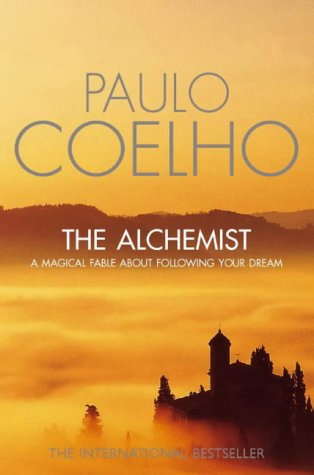
17. Paulo Coehlo: The Alchemist

The Alchemist, Paulo Coelho
Harper UK (HarperCollins), 177 pages, 1988, translated by Alan R. Clarke in 1992

A while ago I was obsessed with asking people on Omegle to tell me their favorite book. 9 out of 10 people responded with some variation of "u r gay," and except for one, all of the rest said Twilight. The last person recommended The Alchemist.

So yeah, it's slightly above the intellectual standard of Twilight, but not by much. I can see why it became a bestseller, and it does have its moments, but I don't really have any patience for the kind of vague pseudo-spiritual mumbo-jumbo it puts forth. I got fed up with it around the time Fatima appeared--nothing annoys me like a cardboard cutout love interest (whose love story with the hero is nevertheless supposed to be somehow significant) in a story where all the men are running around dealing with Important Life Questions. Bitch, please. C-- would not buy again

Next up: This Side of Paradise by F. Scott Fitzgerald

6.16.2011

16. Ursula K. Le Guin: The Left Hand of Darkness

The Left Hand of Darkness, Ursula K. LeGuin
Ace Books (Penguin), 301 pages, 1969

I inherited this book from my predecessor by default, and I honestly had no intention of reading it, but I picked it up randomly off the shelf after deciding I didn't feel like reading any of the (many) books I'd bought in Tokyo. I think I had a vague idea that I should try reading some sci-fi to fulfill my goal of reading a wider variety of genres; I don't know. But outside of the dystopian classics (Brave New World, Fahrenheit 451), it's the first sci-fi I've ever read, and I LOVED it. LOOOOOVED it. It was one of a very few books I've read this year that was completely engrossing (A Wild Sheep Chase was another, and maybe Revolutionary Road), and I know that's such a cliche, but I'm finding that very few books actually fit that description. For hours a day I just immersed myself in this world that the author created. When I finished A Wild Sheep Chase, I was overcome by the urge to see Hokkaido, and when I finished Montana 1948 I added Montana to my Epic American Road Trip 2012 itinerary; obviously no such thing is possible for science fiction, so I just found myself wishing the book would never end.

Since coming to Japan I'm finding myself drawn to stories of cultural isolation, especially if they involve an element of being unable to express oneself through verbal communication (which I think is why I was so moved by The King's Speech). It's kind of crazy to compare my situation to that of a protagonist in a sci-fi novel, but in a lot of ways I related to Genly. The idea of shifgrethor (遠慮?顔を立てる?) The inability of the locals to pronounce your name? The SNOW?? For a while I even wondered if Le Guin had Japan in mind as she wrote it, although I'm sure that's just projection. Anyway, I'll definitely be reading more of her work in the future.

Next up: The Alchemist by Paulo Coelho

6.13.2011

15. Larry Watson: Montana 1948

Montana 1948, Larry Watson
Washington Square Press, 175 pages, 1993

Damn, I'm behind on book posts. I'm on book number 18 now, so I'll try to get through these quickly and get caught up. Anyway, I picked this up at random at the midyear seminar book sale, having never heard of the book or its author before, and was quite pleasantly surprised. The obvious comparison is to To Kill a Mockingbird: small American town, racial injustice, a father taking a difficult stand for what's right, told through a child's eyes. I haven't read To Kill a Mockingbird in about a million years (okay, I can tell you exactly how many years: eight. Oh God.), so I can't really compare the two in any significant way, but I did enjoy Montana 1948. Watson has that kind of writing style that doesn't call attention to itself; it's so easy and transparent that you almost don't notice how well-crafted it is. It's a short read, and suspenseful, but also a good and important one.

Next up: The Left Hand of Darkness by  Ursula K. Le Guin