12.21.2011

38. The Elements of Style

The Elements of Style, William Strunk Jr. and E.B. White
Allyn & Bacon, 95 pages, 2000 (originally published in 1959)

Okay, I have two shocking and embarrassing things to admit here. The first is that I've actually never sat down and read The Elements of Style cover to cover. (Yes, despite the number of times I told you to read it instead of directly critiquing your writing. People who worked with me on [X]Press, feel free to draw and quarter me now.) And the second is that now that I have read it in its entirety, I completely understand why many people think it's outdated.

The trick is in knowing which rules to follow and which to ignore--and if you're the kind of person most desperately in need of this book, you probably don't know the difference. Unfortunately, this makes it useless to tone-deaf writers. The Elements of Style is most useful to teachers and editors who are trying to verbalize principles that come intuitively to them. I've seen so many writers fail to follow even basic principles such as "Keep related words together" (not to mention pretty much all of the ones involving comma placement and usage), and White clearly and simply explains the problem and how to fix it where I could only sputter incoherently and/or drink as I edited. Many of the rules in the "Misused Words and Expressions" chapter have become obsolete by descriptivist standards, if they were indeed ever correct in the first place and not just personal quirks of William Strunk Jr. (as E.B. White's preface seems to indicate). But certain sections of the book are pure gold. It is itself an example of the principles it outlines; it's beautifully written, often funny (though always understated), vivid and fresh. It can improve writing at all levels; some principles ("Write with nouns and verbs") involve a bit of finesse, others ("Be clear") are deceptively simple, but all of them make me realize just how far I still have to go. Reading it makes me want to be a better writer and editor.

Oh, and guess what? This is my blog and I can make a post consisting almost entirely of quotations from The Elements of Style if I want to. Suck it.

"It is nouns and verbs, not their assistants, that give good writing its toughness and color."

Two examples for Principle of Composition #16, "Use definite, specific, concrete language": "He showed satisfaction as he took possession of his well-earned reward." vs. "He grinned as he pocketed the coin."


On parallel construction for related concepts: "The unskilled writer often violates this principle, mistakenly believing in the value of constantly varying the form of expression."


An example of the consequences of not keeping related words together: "New York's first commercial human-sperm bank opened Friday with semen samples from eighteen men frozen in a stainless steel tank ... In the lefthand version of the third example, the reader's heart goes out to those eighteen poor fellows frozen in a steel tank."


"Inexperienced writers not only overwork their adverbs but load their attributives with explanatory verbs: 'he consoled,' 'she congratulated.' They do this, apparently, in the belief that the word said is always in need of support, or because they have been told to do it by experts in the art of bad writing." (In English classes from elementary school on up through high school, we received a handout of a list of synonyms for "said" to use in our writing. I think Mrs. Hillesland might have even given us one.)


"When you become hopelessly mired in a sentence, it is best to start fresh; do not try to fight your way through against the terrible odds of syntax." 


"Young writers often suppose that style is a garnish for the meat of prose, a sauce by which a dull dish is made palatable. Style has no such separate entity; it is nondetachable, unfilterable."

12.19.2011

37. The Adventures of Tom Sawyer

The Adventures of Tom Sawyer, Mark Twain
Signet Classics, 215 pages, 1876

I decided to read this because after finishing Huck Finn I wanted to hang out with Mark Twain and his wonderful narrative voice for just a little longer, and it was already on my shelf. Mark Twain (like Haruki Murakami) is one of those authors who could write about anything and still have my interest. I kind of wish I had read it before Huck Finn, just for the extra insights into Huck's character, which were really all I got out of this. I wish I had more to say about it but being unable to finish this post is keeping me from posting about other books that I have LOTS to say about, so up this goes.

12.12.2011

36. Adventures of Huckleberry Finn

Adventures of Huckleberry Finn, Mark Twain
Google e-book, 313 pages, 1885

Earlier this year, a publisher decided to print an edition of Adventures of Huckleberry Finn that substituted "slave" for a certain infamous racial slur that occurs 219 times in the novel. This is not all that interesting in and of itself, but around the same time, this jackass decided to attempt to turn around a lifetime of violent racism by "apologizing" for it on national television, and a comment on Metafilter decided to pull the two stories together and set a quote from said jackass ("And I found out there is no way I could be saved and get to heaven and still not like blacks") against the climactic scene in Huck Finn, in which Huck decides that he will go to hell rather than turn Jim in to his owner. That comparison alone was enough to make me reconsider the novel I'd read as an 11th grade AP English student and completely dismissed because it was written in dialect and was about a bunch of hicks and, like, slavery was over anyway. (Oh how embarrassing it is to recall this.)

Upon rereading, I still don't think Huckleberry Finn is a watershed moment in the history of American race relations. The climax is a truly life-changing and dramatic moment, but there are so many problems in the rest of the book (particularly the portrayal of Jim as a servile buffoon) that it loses some of its impact, and overall the messages are mixed. I do admire it for other reasons, though. Huck's voice is charming and expressive, and signified a break from proper British prose and the beginning of a genuine American literature. The book works best as a coming-of-age story, the story of Huck's search for freedom and developing sense of right and wrong (not only regarding Jim and slavery but also in scenes like the attempted swindle of the Wilks sisters, from which Jim is completely absent).

Among all the book endings I've read this year (or ever, really), the last paragraph of Huck Finn is one of my favorites:

"Tom's most well now, and got his bullet around his neck on a watch-guard for a watch, and is always seeing what time it is, and so there ain't nothing more to write about, and I am rotten glad of it, because if I'd a knowed what a trouble it was to make a book I wouldn't a tackled it, and ain't a-going to no more.  But I reckon I got to light out for the Territory ahead of the rest, because Aunt Sally she's going to adopt me and sivilize me, and I can't stand it.  I been there before."

(Note: I read this Google ebook, which seems to be the only free copy in Google Books that is plain text instead of a scanned PDF. I think they used some kind of text-recognition software to convert it--most of it is okay, but there are times when it tries to turn dialect into "real" words [for example, "clumb," the past tense of "climb" in Huck's dialect, becomes "dumb"], and it really, REALLY doesn't like Jim's speech and periodically turns it into sprays of random letters and punctuation marks. I had to consult the print version a couple times to figure out what was going on. Probably worth paying the 5 bucks for a paper copy, if you don't live in Japan.)

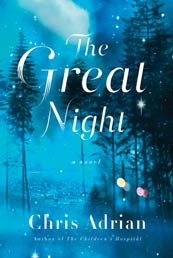
34. The Great Night

The Great Night, Chris Adrian
Farrar, Straus and Giroux ebook, 310 pages, 2011

Holy Shakespeare I am behind on book posts. It's actually been more than a month since I read this now. The Great Night is Adrian's retelling (more of an homage, really) of A Midsummer Night's Dream, set in Buena Vista Park in modern-day San Francisco. Oberon and Titania are recast as supernatural parents who have recently lost their young son to leukemia; the acting troupe becomes a group of homeless people determined to speak out via musical theater about (what they believe is) the mayor's plan to turn the city's homeless into food, and the original play's four lovers are now three heartbroken San Franciscans who become lost in the park on their way to a party. It reminded me a lot of early Francesca Lia Block, after Weetzie Bat but before all the dark confessional stuff, seamlessly and whimsically weaving faeries and magical creatures into a modern-day urban scene--not literary, necessarily, but entertaining and bawdy and a whole lot of fun. On the other hand, my opinion of the book is mixed--I agree with one review (which I can't find now) that said the portrayal of Titania and Oberon as godlike creatures who ultimately cannot prevent or deal with their son's death was by far the best-written and most moving part of the book. The stories of the three human lovers never quite reach a satisfying conclusion, only a threesome.

35. Island Beneath the Sea

Island Beneath the Sea, Isabel Allende
HarperCollins ebook, 419 pages, 2010, translated by Margaret Sayers Peden

Reading Isabel Allende these days is like, I don't know, going to your favorite restaurant and ordering the steak with fries instead of trying out the hip new Ethiopian place*. It's boring (if satisfying); you already know exactly what you're going to get, which in this case is an enormous cast of characters who evolve slowly and aimlessly over a long period of time, sumptuous descriptions of gowns and French meals and ballrooms, beautiful courtesans, honorable soldiers, and a little bit of political unrest. In that sense it was fine, but the problem was that I actually actively disliked all the characters, except the relatively minor Sancho, and maybe (if pressed) Maurice. It was a little disappointing overall, but I'll probably still read whatever she comes out with next.

*If your immediate, instinctive response to this is "HURF DURF I DIDN'T KNOW THEY EVEN HAD FOOD IN ETHIOPIA," please re-evaluate your life